Quadriceps Strain
Severity: Mild to Severe depending on grade
Typical recovery time: Grade 1: 2–3 weeks; Grade 2: 4–8 weeks; Grade 3: 3–6 months, with possible surgery
Can I keep running? No for Grade 2 and 3 strains. Grade 1 strains may allow a return to light activity within days but should avoid sprinting
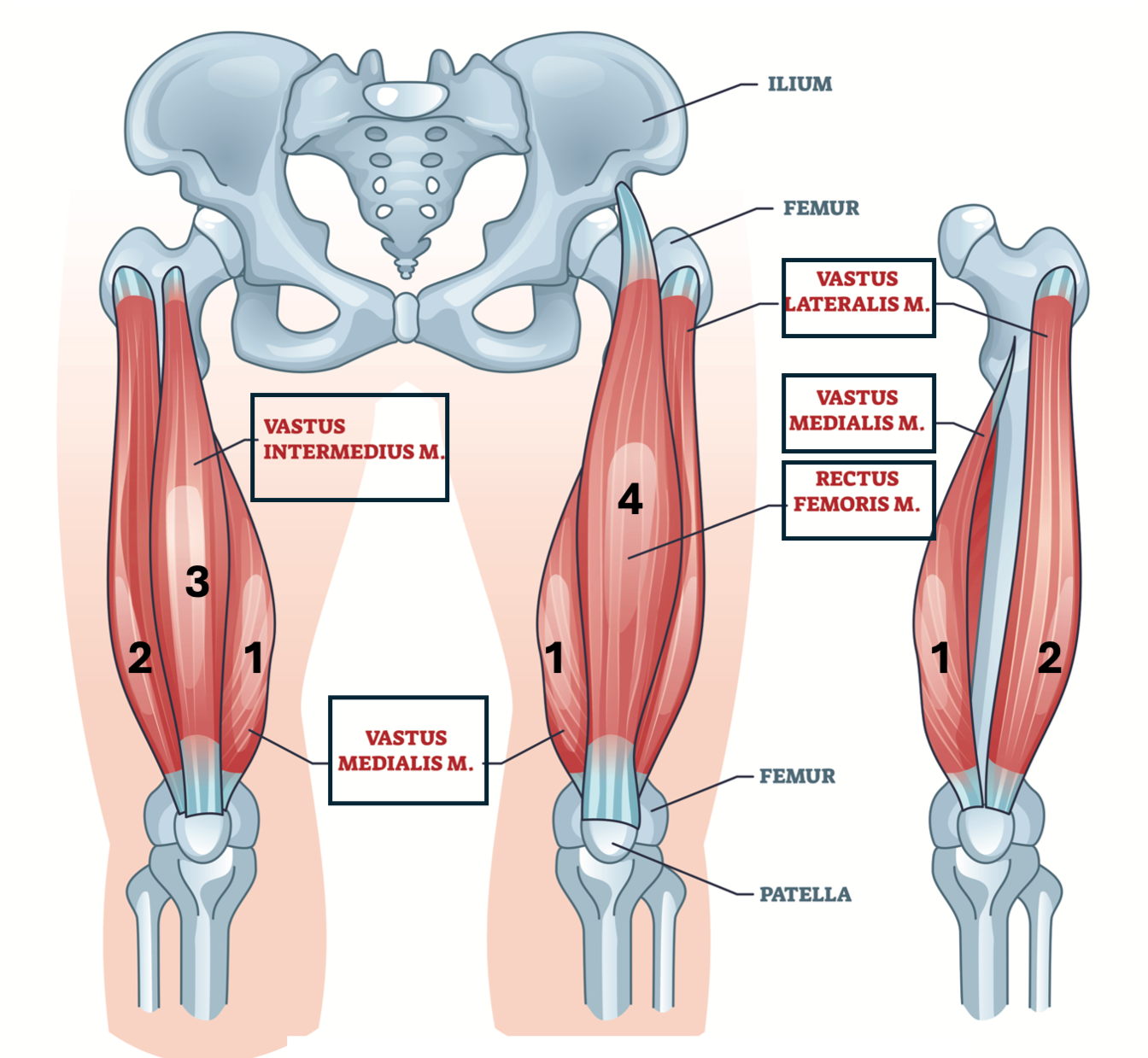
What's Actually Happening: The quadriceps is made up of four muscles at the front of the thigh: the rectus femoris, vastus lateralis, vastus medialis, and vastus intermedius, which collectively extend the knee and power the push-off and swing phases of running. Quadriceps strains occur when one of these muscles is forced to generate more force than it can handle, causing fibers to tear. The rectus femoris is the most commonly injured since it crosses both the hip and knee joints, making it vulnerable during the toe-off phase of sprinting when the hip is extended and the knee simultaneously flexing. In track athletes this injury most often happens during sudden acceleration, transitioning from a jog to a sprint, or during explosive hill efforts. Strains are graded 1 through 3: Grade 1 involves minor fiber damage with no strength loss, Grade 2 is a partial tear with noticeable pain and reduced strength, and Grade 3 is a complete rupture that may visibly appear as a gap or dent in the muscle and occasionally requires surgery.
How You Know It's This (Symptoms):
Sudden sharp pain at the front of the thigh during sprinting, jumping, or explosive movement
In Grade 1 strains, a dull ache or tightness in the front thigh that may not appear until after training
Tenderness on direct palpation of the front thigh, usually in the middle or upper portion
Swelling and bruising that develop within hours of a Grade 2 or 3 strain
Difficulty bending the knee past 90 degrees or straightening the leg against resistance
In Grade 3 strains, a visible gap or dent in the muscle and severe inability to walk without assistance
What To Do Right Now:
Stop running immediately if pain is sharp or if the leg feels weak during push-off
Apply ice wrapped in a cloth for 15–20 minutes every 2–3 hours in the first 48–72 hours
Apply a compression bandage from the knee upward along the thigh and elevate the leg when resting
Avoid stretching the quad aggressively in the first few days as this can pull directly on the torn fibers and worsen the injury
When to See a Professional:
A felt or heard pop at the moment of injury, a visible gap in the muscle, or an immediate inability to walk without significant assistance, all suggesting Grade 3 involvement
Bruising that is extensive or spreads rapidly down the leg
Symptoms that don't improve after 5–7 days of rest and basic conservative care for what appears to be a mild strain
Returning athletes who feel a re-tear in the same location
How to Treat It
Progressive rehabilitation from the start: Early intervention with properly structured physical therapy significantly improves outcomes and reduces re-injury risk. The goal is to progress through three phases — early pain management and isometric loading, then progressive strengthening, then sport-specific loading.
Isometric loading first: Wall sits performed with the knee at a tolerable angle are one of the most practical early exercises, loading the quad without requiring joint movement. These can begin within the first few days of a Grade 1 strain and within the first week or two of a Grade 2 once acute pain settles.
Eccentric strengthening: Eccentric quad work, where the muscle lengthens under load, is the cornerstone of the strengthening phase. Slow, controlled step-downs and eccentric leg extensions are core exercises during this phase, since eccentric strength is what controls deceleration during running and is the most important component for re-injury prevention.
Instrument-assisted soft tissue mobilization (IASTM) and dry needling: These adjunct treatments have clinical support and are appropriate alongside progressive exercise rehabilitation. A published case report involving a high school track athlete with a Grade 2 quad strain found that a combination of multimodal chiropractic intervention, IASTM, rehabilitative exercises, and dry needling allowed full return to competition in 7 days, with the athlete setting personal records afterward.
Massage: Gentle soft tissue work along the quadriceps during the subacute phase improves circulation and reduces scar tissue formation, which is particularly important given the risk of re-injury at inadequately healed scar tissue sites.
Compression: A compression bandage during activity provides support and proprioceptive feedback during the return to running phase and is a practical adjunct throughout rehabilitation.
The Recovery Plan:
Week 1–2: Rest from running, ice and compress consistently, and begin isometric wall sits as pain allows. Grade 1 strains can often begin light activity within a few days but should wait the full 2–3 weeks before any sprinting. Grade 2 strains need full rest from running during this phase.
Week 2–6: Progress to eccentric strengthening, resistance band exercises, and functional movements as the muscle tolerates increasing load. Light jogging on flat ground is appropriate for Grade 2 strains toward the end of this phase once walking is pain-free, the knee can be fully bent without discomfort, and isometric strength feels close to symmetrical with the uninjured side.
Week 6 onward: Gradually reintroduce faster running, hills, and acceleration work. Sprinting should be the last thing to return, not the first, since it places the highest eccentric demand on the rectus femoris at the end of the swing phase. Grade 2 strains typically return to full training within 6–8 weeks with consistent rehabilitation.
