Adductor (Groin) Strain
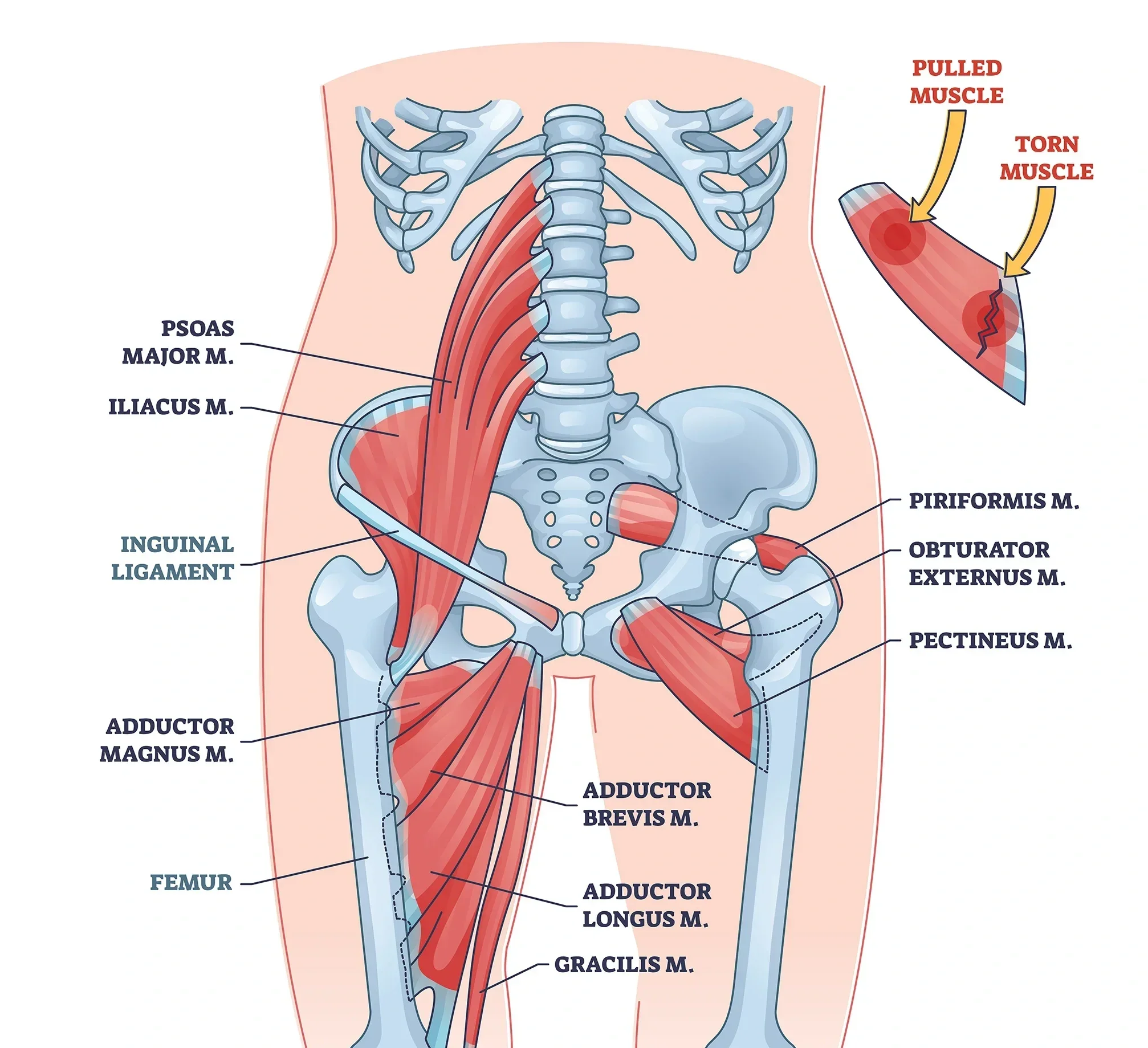
Severity: Mild to Severe, depending on grade
Typical recovery time: Grade 1: 1–2 weeks; Grade 2: 3–6 weeks; Grade 3: several months
Can I keep running? Mild Grade 1 strains may allow easy jogging under the right conditions, but changing stride to compensate or running through worsening pain are signs to stop immediately
What's Actually Happening: The adductors are a group of three muscles on the inner thigh, the magnus, longus, and brevis, that bring the legs toward each other and play an important role in stabilizing the pelvis during running. The adductor longus is the most commonly injured of the three. A strain occurs when these muscles are overstretched or forced to generate more force than they can handle, causing tears ranging from microscopic (Grade 1) to a complete rupture (Grade 3). In runners, adductor strains most often occur during sudden accelerations, hill sprinting, or running on uneven terrain where the leg is forced outward. Adductor weakness compared with the uninjured side is a significant risk factor for acute adductor injury, and weak glutes compound the problem by shifting the stabilization burden onto the adductors during the stance phase of running. Chronic groin pain that doesn't resolve properly is a real risk if these strains are undertreated, with longstanding adductor-related groin pain syndrome known to persist for an average of nine months in athletes who don't address the root cause.
How You Know It's This (Symptoms):
Sharp or aching pain along the inner thigh and groin during or immediately after running, sprinting, or lateral movement
Tenderness on direct palpation of the inner thigh muscles, most commonly near the groin crease where the adductor longus attaches
Pain reproduced by squeezing the legs together against resistance, and by stretching the groin with the legs spread apart
Muscle spasms in the inner thigh in more significant strains
Bruising or discoloration along the inner thigh in Grade 2 and 3 tears
Pain that's sharp and isolated in the inner thigh right after a hard effort suggests a strain; pain that's deep, nagging, or radiating warrants professional evaluation to rule out other causes
What To Do Right Now:
Stop running immediately if pain is sharp or worsening during a run
Apply ice for 15–20 minutes every 2–3 hours in the first 48 hours
Compression shorts help stabilize the area and reduce swelling in the early phase
Avoid stretching the groin aggressively in the first few days, as this places direct tension on acutely torn muscle fibers
When to See a Professional:
Significant bruising, inability to walk without a limp, or severe pain suggesting a Grade 3 tear
Pain that is deep, nagging, or radiating rather than clearly located in the inner thigh muscle belly, since this pattern warrants evaluation to rule out hip labral involvement or pubic stress injuries
Symptoms that don't improve after 2–3 weeks of conservative management
Longstanding groin pain that keeps recurring in the same area, since chronic adductor-related groin pain requires a structured rehabilitation approach
How to Treat It:
Active rehabilitation over passive treatment: Research comparing active exercise programs to passive treatment found that active programs were significantly more effective at enabling athletes to return to sport without groin pain, with an odds ratio of 12.7. This means exercise-based rehabilitation isn't just one option, it's the most evidence-supported approach by a considerable margin.
Adductor strengthening: Progressive adductor strengthening is the treatment with the highest level of evidence for adductor problems. The Copenhagen adductor exercise is highlighted as the most efficient approach for both rehabilitation and prevention, specifically targeting eccentric muscle function which is the primary risk factor for groin injury. It progresses from a short lever version with the knee bent on a bench to a full straight-leg version as strength improves.
Isometric loading early: Isometric adductor contractions, where you squeeze the legs together against resistance without movement, are appropriate in the early phase when more dynamic loading is too painful. These activate the adductors without stressing the torn fibers excessively.
Glute and core strengthening: The adductors don't work in isolation. Weak glutes shift stabilization demands onto the inner thigh during running, so clamshells, bridges, and Copenhagen side planks are important components of a complete rehabilitation plan.
Manual therapy: Soft tissue release and manual therapy in the early phase can help manage pain and tissue quality, though research consistently shows it should complement rather than replace active exercise. Manual therapy alongside strengthening shortens return to sport compared to passive treatment alone.
Compression clothing: Compression shorts have some evidence behind them as an adjunct treatment for adductor-related groin pain, providing support and proprioceptive feedback during rehabilitation and return to running.
The Recovery Plan:
Week 1–2: Rest from running, ice and compress, and begin isometric adductor contractions as soon as pain allows. Grade 1 strains often return to easy running toward the end of this window with careful monitoring.
Week 2–6: Progress to Copenhagen adductor exercises, glute strengthening, and core stability work. Light jogging on flat ground is appropriate for Grade 2 strains once walking is fully pain-free and isometric work is tolerated without symptoms. Avoid sprinting, hill running, and lateral movements until strength is significantly restored.
Week 6 onward: Gradually reintroduce faster running, hills, and direction changes as strength symmetry returns. The injured leg should have adductor strength comparable to the uninjured side before returning to full training intensity. Grade 2 strains typically return to full training within 6–8 weeks with consistent rehabilitation.
