Hip Flexor Strain
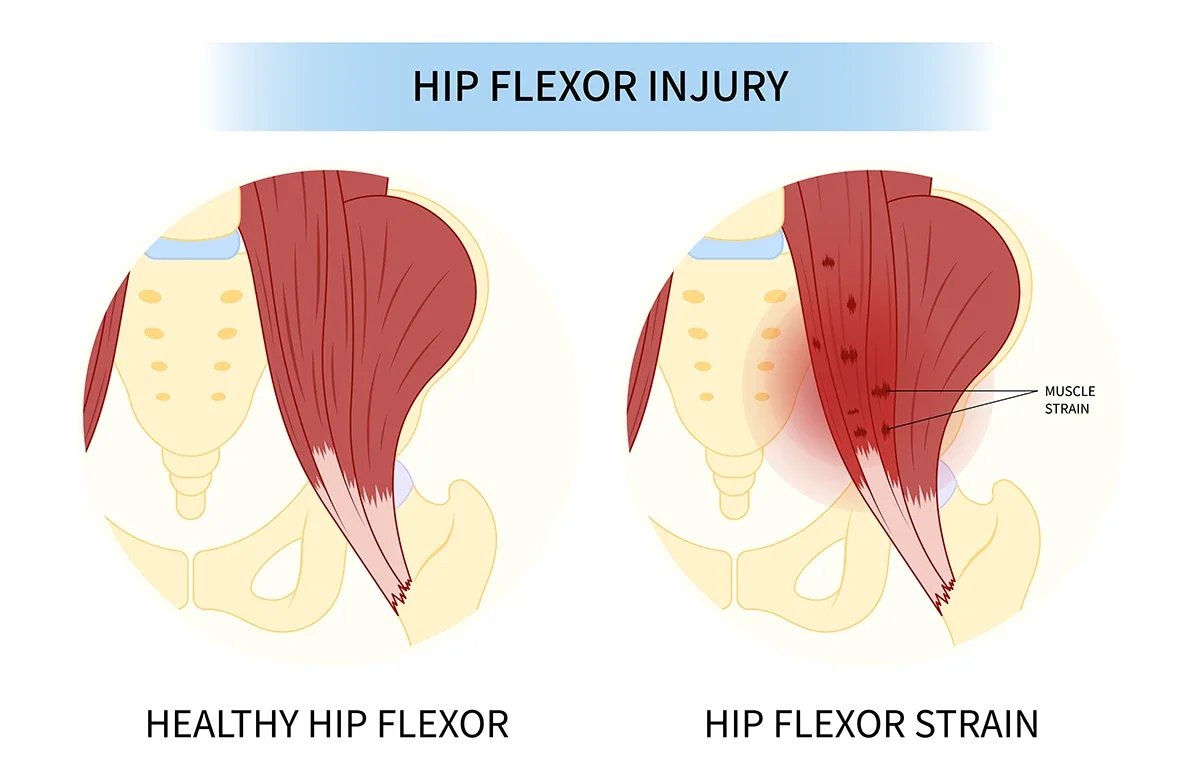
Severity: Mild to Moderate in most cases; Severe for Grade 3 tears
Typical recovery time: Grade 1: 1–3 weeks; Grade 2: 4–8 weeks; Grade 3: several months
Can I keep running? Not immediately; returning before the strain has healed significantly increases re-injury risk; adequate rest and rehabilitation are needed
What's Actually Happening: The hip flexors are a group of muscles, primarily the iliopsoas and rectus femoris, responsible for lifting the thigh toward the body during the swing phase of running. A hip flexor strain occurs when one or more of these muscles are overstretched or torn, typically during sudden, explosive movements such as sprinting, accelerating, or rapidly changing direction. Restricted hip mobility and hip flexor-extensor imbalances are consistently linked in research to running injuries and reduced running economy, meaning this isn't just an acute injury but often a sign of an underlying movement pattern worth addressing. Contributing factors include weak or imbalanced hip muscles, inadequate warm-up before hard efforts, tight hip flexors from prolonged sitting, and sprinting at speeds the muscle isn't yet conditioned to handle. The majority of hip flexor strains are Grade 2 — partial tears — rather than the milder Grade 1, which means most cases require more than a few days of rest to fully heal.
How You Know It's This (Symptoms):
Sharp or cramping pain at the front of the hip — the area where the thigh meets the pelvis — during or immediately after sprinting or explosive movement
In milder cases, tightness and pulling at the front of the hip that develops gradually during a run rather than suddenly
Pain that increases with sprinting, stair climbing, and lifting the knee toward the chest
Difficulty getting out of a chair or rising from a squat without significant discomfort
In more significant strains, a noticeable limp and pain even during normal walking
What To Do Right Now:
Stop running and avoid sprinting, kicking, and any movement that requires lifting the knee against resistance
Apply ice for 15–20 minutes several times daily in the first 48 hours
Compression shorts or wraps can help stabilize the area and reduce swelling in the early phase
Avoid aggressive hip flexor stretching immediately after the injury
When to See a Professional:
Sharp shooting pain, numbness, tingling, or weakness in the leg alongside hip pain, as these suggest nerve involvement and need evaluation
Any clicking, catching, or locking deep in the hip joint, as this could indicate labral involvement rather than a simple muscle strain
Grade 3 tears with significant weakness and inability to walk normally require imaging and specialist evaluation
Symptoms that don't improve after 2–3 weeks of consistent conservative management
How to Treat It:
Progressive rehabilitation over passive rest: Passive treatment alone- rest, ice, and time- is insufficient for full recovery. A clinical commentary published in the International Journal of Sports Physical Therapy specifically emphasizes progressive strengthening, core stabilization, and a milestone-based return to sport rather than prolonged rest as the standard approach for soft-tissue hip injuries.
Stretching: Gentle hip flexor stretching is appropriate once the acute phase passes; the classic kneeling lunge stretch targets the iliopsoas effectively. Hold for 30 seconds, repeat 3 times, twice daily. Avoid forcing range of motion in the first few days when the muscle is still acutely torn.
Strengthening: Hip flexor strengthening progresses from isometric contractions, pressing the thigh upward against resistance without movement, to concentric and eccentric work. Core stabilization is equally important since the iliopsoas connects to the lumbar spine and pelvis — weak core mechanics increase the load on the hip flexors during running.
Neuromuscular re-education: Restoring proper movement patterns between the hip flexors, glutes, and core is one of the most important parts of rehabilitation for runners specifically. Coordination between these muscle groups is what makes running efficient, and imbalances between them are a primary cause of both initial injury and re-injury.
Dry needling and soft tissue mobilization: For persistent cases not responding adequately to exercise therapy, dry needling and soft tissue mobilization are appropriate adjunct treatments that a physiotherapist or sports medicine clinician can provide.
Gait analysis: Restricted hip mobility and hip flexor-extensor imbalances are consistently linked to running injuries; a gait assessment can identify specific movement faults that contributed to the strain and guide corrections that reduce recurrence risk.
The Recovery Plan:
Week 1–2: Rest from running, ice, and compression. Begin gentle range of motion work and isometric hip flexor contractions as soon as pain allows. Avoid aggressive stretching but maintain gentle movement to prevent stiffness.
Week 2–6: Progress to active strengthening, hip flexor curls, standing knee raises, and core stabilization work. Grade 1 strains often return to easy running during this phase; Grade 2 strains need to complete this phase fully before attempting to run. Light cycling is a good cross-training option during this period.
Week 6–12: Gradual return to running beginning with easy flat efforts. Progress to strides and then faster work only once the hip flexor is pain-free through its full range of motion and strength has been restored symmetrically. Grade 2 strains typically return to full training within this window with consistent rehabilitation.
