Hamstring Strains
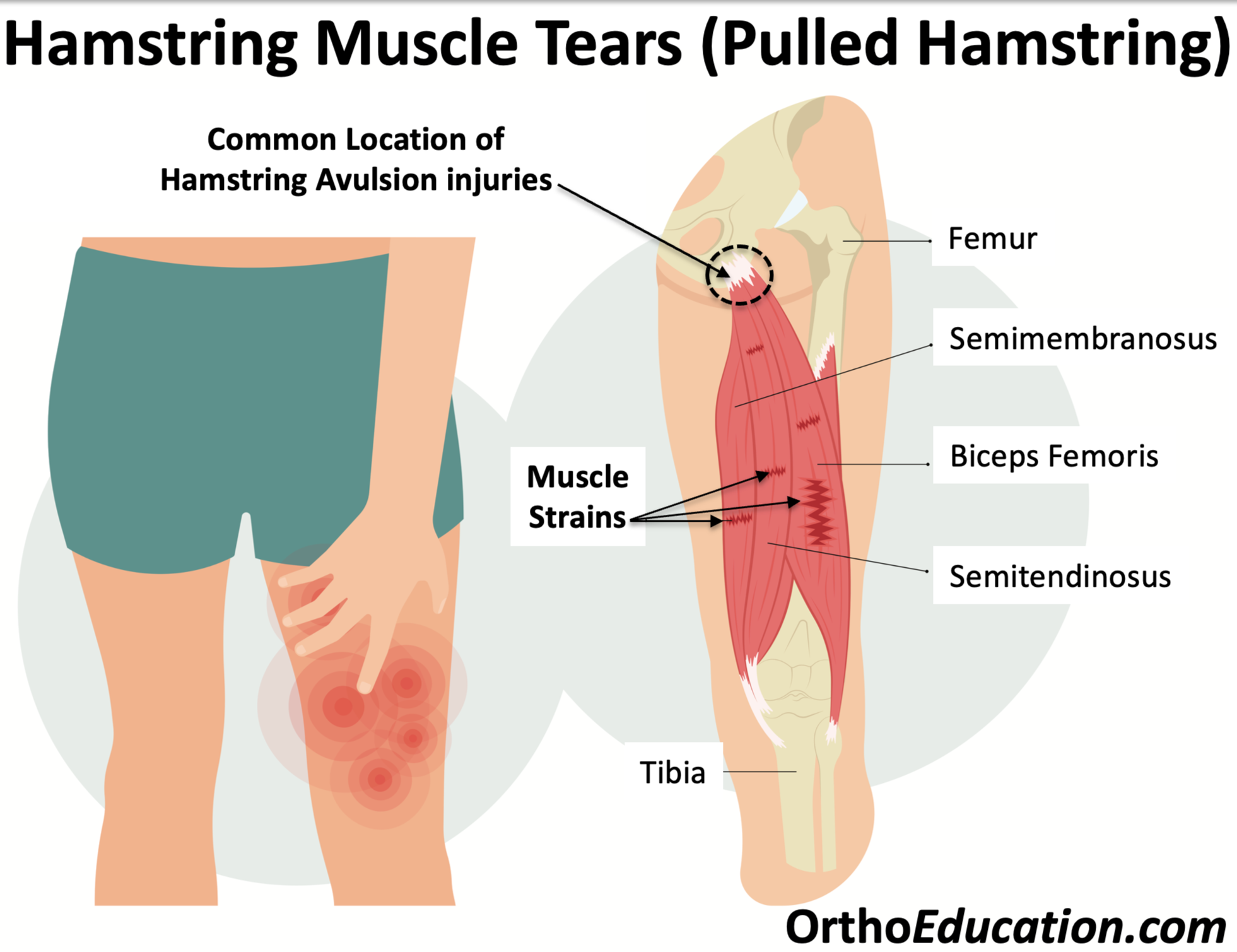
Severity: Mild to severe, depending on grade
Typical recovery time: Grade 1: 1–3 weeks; Grade 2: 3–6 weeks; Grade 3: several months, occasionally requiring surgery
Can I keep running? Not immediately after the injury. Return to running is one of the most important and carefully managed parts of hamstring rehab, and rushing it is the leading cause of re-injury
What's Actually Happening: The hamstring is a group of three muscles — the biceps femoris, semimembranosus, and semitendinosus — running down the back of the thigh from the pelvis to just below the knee. These muscles absorb and generate enormous forces during running, particularly during high-speed sprinting when they decelerate the swinging leg just before foot strike. Hamstring strains are one of the most common sports injuries overall and are graded 1 through 3 based on severity: Grade 1 involves microscopic tears with little swelling or strength loss, Grade 2 is a partial tear with noticeable pain and reduced strength, and Grade 3 is a complete rupture. One of the most critical facts about this injury is the re-injury rate; those who have had a previous hamstring strain are 3.6 times more likely to sustain another one, and nearly one-third of hamstring strains recur within the first year after return to sport. This high re-injury rate is largely attributed to inadequate rehabilitation and premature return to running before full strength is restored.
How You Know It's This (Symptoms):
A sudden sharp pain or snapping sensation at the back of the thigh during sprinting, acceleration, or an explosive movement
In Grade 1 strains, a feeling of tightness or cramping in the back of the thigh during or after a run rather than a sudden sharp pain
Tenderness on direct palpation of the hamstring muscle belly, typically in the middle or upper portion of the back of the thigh
Pain reproduced by bending forward to stretch the hamstring with a straight knee, or by bending the knee against resistance
Bruising on the back of the thigh that develops in the hours or days following more significant tears
What To Do Right Now:
Stop running immediately
Apply ice wrapped in a cloth for 15–20 minutes every 2–3 hours in the first 48 hours
Apply a compression wrap to the back of the thigh to control swelling
Avoid aggressive stretching in the first 72 hours; this is counterintuitive but stretching an acutely torn muscle can disrupt the initial healing response and worsen the injury
Grade 3 strains require prompt medical evaluation
When to See a Professional:
Any felt or heard pop at the moment of injury, significant bruising, or inability to walk without a limp — these suggest at least a Grade 2 strain
Suspected Grade 3 tears require imaging and orthopedic evaluation before beginning rehabilitation
Hamstring strains that recur in the same location
Any proximal hamstring pain near the sitting bone that doesn't improve, proximal hamstring tendinopathy or avulsion injuries require a different management approach
How to Treat It:
Early movement over immobilization: A protocol of brief immobilization followed by early controlled movement has shown better outcomes than prolonged rest — one study found an average return to sport of approximately 2 weeks using early mobilization for Grade 1 and 2 strains with a 6.2% re-injury rate, which is significantly better than protocols that emphasize extended rest.
Progressive loading: The rehabilitation should progress through three phases, isometric loading first, then concentric and eccentric work, then sport-specific movements including progressive running. Returning to high-speed running is arguably the most important aspect of rehabilitation since it's both fundamental to running performance and one of the most common mechanisms of re-injury.
Eccentric strengthening: Eccentric hamstring exercises are the cornerstone of both treatment and re-injury prevention. Nordic hamstring curls are the single most well-evidenced intervention for reducing hamstring injury incidence and should be a core component of rehabilitation once the acute phase passes. They're also worth incorporating into your training permanently afterward.
Neuromuscular control: Balance, coordination, trunk stability, and lower limb control exercises should be included throughout rehabilitation — not just isolated hamstring strengthening. Hip extensor strengthening specifically helps prepare the hamstring for the demands of high-speed running.
MRI: Evidence does not support routine MRI for Grade 1 and 2 hamstring strains since it doesn't significantly change the treatment plan or improve return-to-sport prediction beyond a thorough clinical examination. Reserve imaging for Grade 3 tears or cases that aren't progressing as expected.
Massage and soft tissue therapy: Gentle soft tissue work to the hamstring during the subacute phase improves circulation, reduces muscle tension, and helps manage scar tissue formation, which is particularly important given how commonly inadequately healed scar tissue contributes to re-injury.
The Recovery Plan:
Week 1–2: Rest from running, ice and compression, and avoid aggressive stretching. Begin gentle range of motion work and isometric hamstring contractions, pressing the heel down against the floor without movement, as soon as pain allows. Grade 1 strains often return to sport within this window with appropriate management.
Week 2–4: Progress to concentric and eccentric strengthening as pain allows. Begin Nordic hamstring curl progressions and hip extensor work. Light jogging on flat ground is appropriate for Grade 1 strains once walking is completely pain-free, for Grade 2 strains this phase typically begins later.
Week 4–8: Progress toward high-speed running drills. Return to sprinting should be gradual and guided by strength symmetry — the injured leg should have at least 90% of the eccentric hamstring strength of the uninjured leg before attempting full-speed sprinting, since this is the most common threshold used clinically to determine readiness. Grade 2 strains typically return to full training within this window with consistent rehabilitation.
