Piriformis Syndrome
Severity: Mild to Moderate in most cases
Typical recovery time: Several weeks to a few months with consistent treatment; cases that are caught early and addressed with targeted rehabilitation tend to resolve significantly faster
Can I keep running? Often yes at reduced intensity. Cut out speed work and hill sessions until symptoms settle. If running itself provokes pain, cycling or the elliptical are better options to maintain fitness.
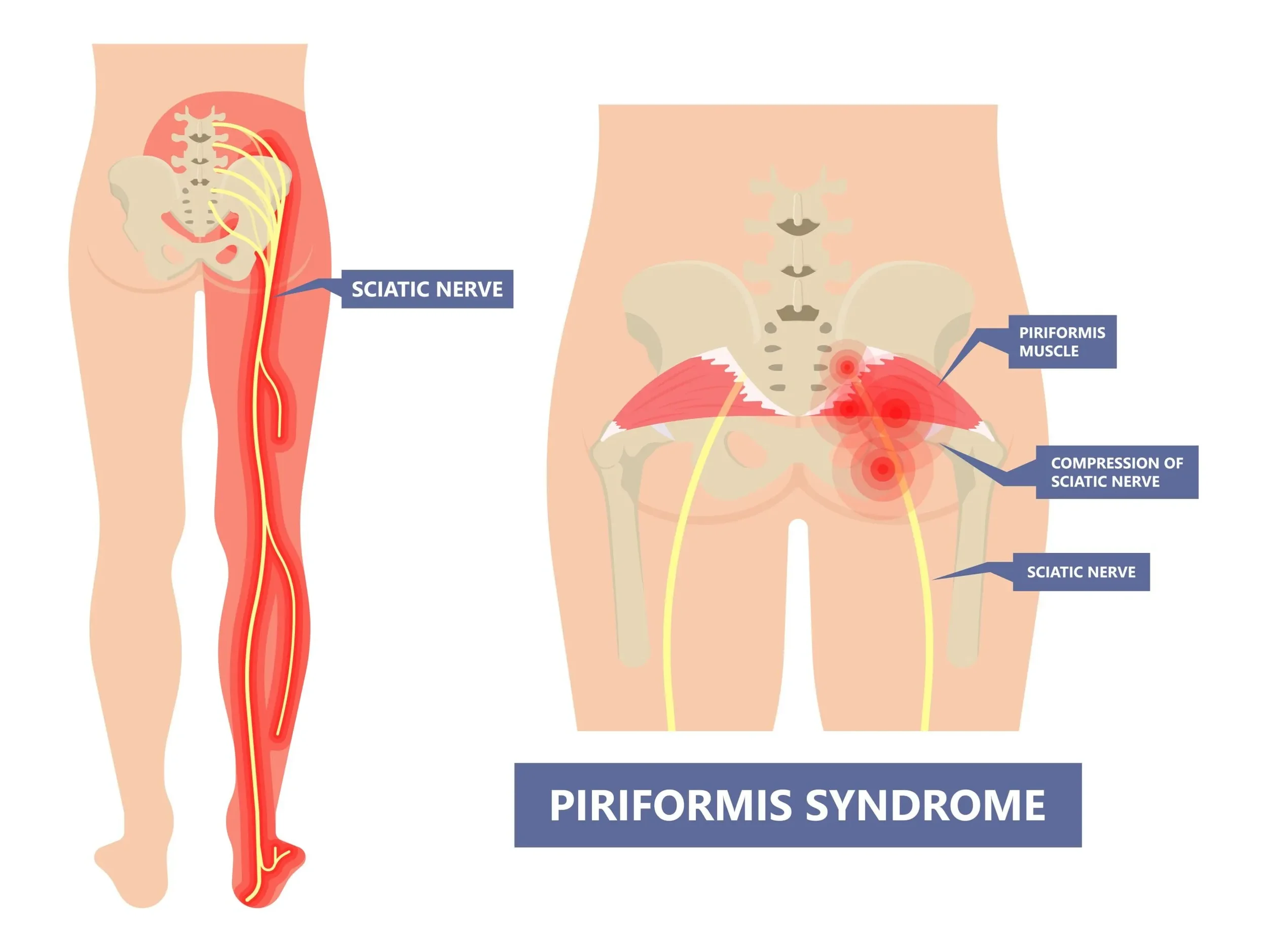
What's Actually Happening: The piriformis is a small, pear-shaped muscle sitting deep in the buttock, connecting the sacrum to the top of the femur. Its job is to rotate the hip outward and stabilize the pelvis during the stance phase of running. The sciatic nerve, the largest nerve in the body, runs directly beneath the piriformis, and in roughly 17% of people it actually passes through the muscle. When the piriformis becomes tight, irritated, or inflamed, it can compress the sciatic nerve and produce symptoms that radiate from the buttock down the back of the leg, closely mimicking sciatica from a spinal source. This overlap is one of the main reasons piriformis syndrome is frequently misdiagnosed and one of the most common running injuries. Women are significantly more affected than men, with a female-to-male ratio of approximately 6:1. Contributing factors in runners include hip muscle weakness, particularly in the glutes, excessive hip internal rotation during running, prolonged sitting between sessions, and anatomical variations in sciatic nerve positioning.
How You Know It's This (Symptoms):
A deep aching soreness or sharp pain in the center of the buttock, distinct from lower back pain
Shooting, tingling, or burning pain that radiates from the buttock down the back of the thigh, sometimes as far as the calf
Pain that worsens with prolonged sitting, especially with the hip in a crossed-leg position
Tenderness deep in the gluteal area when pressed
Pain that increases during running, particularly when picking up pace or running uphill
What To Do Right Now:
Reduce running volume and eliminate speed work and hills immediately
Avoid prolonged sitting where possible, and avoid crossing the affected leg over the other when seated
Apply ice to the buttock area for 15–20 minutes after activity during the acute phase, transitioning to heat once the initial irritation settles
Begin very gentle piriformis stretching, the figure-four or pigeon pose stretch, as soon as pain allows
When to See a Professional:
Pain that radiates significantly down the leg with numbness or tingling, as this pattern warrants professional evaluation to rule out lumbar disc involvement before treating as piriformis syndrome
Symptoms that don't improve after 2–3 weeks of reduced training and targeted stretching
A diagnosis that isn't clear, since piriformis syndrome, lumbar sciatica, and hip labral tears can all present with similar gluteal pain patterns
Corticosteroid injections directly into the piriformis muscle are an option for persistent cases not responding to conservative treatment and should be discussed with a sports medicine physician
How to Treat It:
Piriformis stretching: Consistent stretching of the piriformis is the most universally recommended conservative treatment. The figure-four stretch, where you cross the affected leg's ankle over the opposite knee and gently press the knee away, is the most practical option for runners. Hold for 30 seconds and repeat 3 times, at least twice daily. Stretching after a warm shower or light warm-up is more effective than cold stretching.
Hip strengthening: Research has consistently linked hip muscle weakness to piriformis syndrome development, and a hip strengthening program is one of the most evidence-supported treatment approaches available. If the glute max is weak, glute bridges are a safe first exercise since the movement pattern doesn't overload the piriformis. If the glute medius is weak, clamshells are a good initial option. Once these activate well, progress to weight-bearing and single-leg exercises for lasting improvement.
Foam rolling and massage: Foam rolling the glutes and using a spiky ball directly on the piriformis region improves tissue quality and circulation. This is appropriate from early in treatment and should be done before stretching to improve tissue pliability. Deep massage to the gluteal region by a physiotherapist or sports massage therapist can provide additional relief in more persistent cases.
Gait retraining: Addressing hip mechanics during running is an important part of treatment that is often overlooked. Excessive hip internal rotation during stance, overpronation, and a narrow running stance all increase the load on the piriformis. Adjusting these patterns with guidance from a physiotherapist reduces ongoing irritation to the muscle during running.
Shockwave therapy: Radial shockwave treatment has been compared to corticosteroid injection in research, with shockwave producing faster initial pain reduction at one week follow-up. It's a useful option for persistent cases that haven't responded adequately to exercise and stretching.
Orthotics: For runners whose piriformis symptoms are linked to foot mechanics and pelvic alignment issues, an orthotic consultation is worth pursuing to address contributing biomechanical factors.
The Recovery Plan:
Week 1–2: Reduce running significantly, avoid hills and speed work, and begin piriformis stretching twice daily. Ice after activity, transitioning to heat application before stretching sessions. Begin glute bridge and clamshell work if tolerated.
Week 2–6: Progress hip strengthening to weight-bearing exercises and add gait awareness to running sessions. Run/walk intervals are appropriate if continuous running is still uncomfortable. Foam roll daily before stretching.
Week 6 onward: Gradually reintroduce normal running volume, then speed work and hills last. Runners should be cautious when resuming speed training and hill running, doing so gradually with proper warm-up and cool-down. A daily stretching program is crucial to avoid recurrence even after full return to training.
