Femoral Neck Stress Fractures
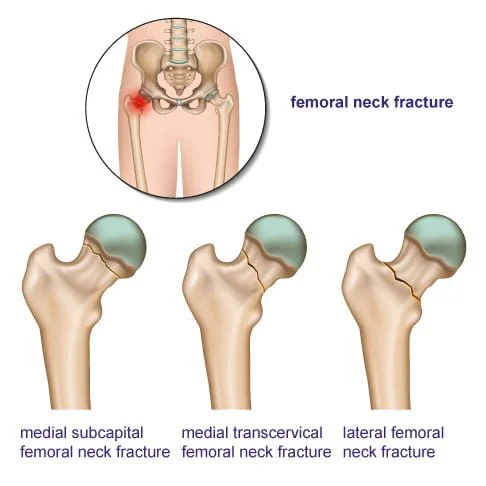
Severity: Severe
Typical recovery time: Non-displaced fractures treated conservatively heal within 8–14 weeks, though full return to running typically takes 4–7 months. Displaced fractures requiring surgery have significantly longer recovery timelines
Can I keep running? Absolutely not. This is one of the most serious stress fractures in distance running, and running through it risks displacing the fracture, which can lead to avascular necrosis of the femoral head and permanent hip joint damage.
What's Actually Happening: The femoral neck is the narrow section of bone connecting the head of the thigh bone to the shaft, sitting just below the hip joint. It handles enormous forces during running and is particularly vulnerable to stress fractures because it experiences both compressive forces on its lower surface and tensile forces on its upper surface with every stride. Femoral neck stress fractures account for only 2–5% of all stress fractures in athletes, but they carry a significantly higher complication rate than most other stress fractures, with morbidity rates ranging from 20–86% in cases involving complete fracture, malunion, avascular necrosis, or arthritic changes. The average delay in diagnosis is around 14 weeks, meaning runners are often unknowingly training through this injury for months before it's identified. Women are at significantly higher risk than men, particularly those with the Female Athlete Triad, which involves disordered eating, amenorrhea, and reduced bone density. The location of the fracture on the femoral neck determines the treatment approach: compression side fractures on the lower surface are more stable and often managed conservatively, while tension side fractures on the upper surface are at higher risk of displacement and typically require surgical fixation.
How You Know It's This (Symptoms):
Deep, vague pain in the groin, front of the hip, or inner thigh that worsens with running and is relieved by rest in the early stages
Pain that progressively increases with continued training rather than fluctuating like a muscle injury
Pain reproduced by passive hip internal rotation during examination, which is one of the more specific clinical signs
Hopping reproduces the groin or hip pain
In more advanced cases, pain that becomes present even during normal walking or at rest
What To Do Right Now:
Stop all running and impact activity immediately and do not attempt to walk it off or reduce training gradually
Non-weight-bearing status with crutches is often required until imaging confirms the type and severity of the fracture
Go to a doctor or emergency room the same day if pain is severe or if walking is painful, since displacement is the primary complication risk and early treatment significantly changes outcomes
Do not wait to see if it improves on its own, as the consequences are potentially permanent
When to See a Professional:
Any deep groin or hip pain that progressively worsens over days of continued training, even if it eases with rest initially
Plain X-rays are typically normal in the early stages, so push for an MRI if groin or hip pain persists, and the X-ray is inconclusive
All treatment decisions, including whether surgery is needed, must be made by an orthopedic surgeon based on fracture location, displacement status, and imaging findings
Female runners with irregular periods, low body weight, or a history of disordered eating should have a lower threshold for seeking evaluation when hip or groin pain develops, given the significantly elevated risk in this group
How to Treat It:
Conservative management for non-displaced fractures: The majority of femoral stress fractures that lack displacement respond to conservative treatment within 8–14 weeks. This involves complete rest from running and high-impact activity, initial non-weight-bearing with crutches, and a very gradual progression back to weight-bearing guided by imaging and symptoms.
Surgery for displaced or tension-side fractures: Tension-side fractures on the upper surface of the femoral neck are considered high-risk and surgical internal fixation with screws is typically recommended to prevent displacement. In a published case series of four recreational runners with femoral neck stress fractures, three of the four required surgical fixation, with all four returning to sport activity after recovery.
Nutritional support: Adequate calcium, vitamin D, and overall caloric intake are essential for bone healing. Blood testing for vitamin D and parathyroid hormone levels is standard in assessment since nutritional deficiencies are commonly identified in this population and directly affect healing speed. In one documented case, a runner was completely pain-free at three-month follow-up with healing confirmed on imaging alongside normalization of vitamin D levels.
Physiotherapy: Rehabilitation includes pain management techniques, hip and thigh strengthening to support the healing femur, and flexibility work. Stationary cycling and swimming are the appropriate cross-training options since both unload the femoral neck while maintaining cardiovascular fitness. The progression back to running is guided strictly by clinical assessment and imaging rather than by symptoms alone.
Bone density assessment: A DEXA scan to assess bone mineral density is appropriate for any runner who develops a femoral neck stress fracture, particularly in the presence of any Female Athlete Triad risk factors. Addressing underlying bone density issues is as important as treating the fracture itself for preventing recurrence.
The Recovery Plan:
Week 1–6: Complete rest from running and all high-impact activity. Non-weight-bearing with crutches as directed by your surgeon or physician. Begin swimming or stationary cycling as pain allows and clearance is given. Focus on nutrition including calcium and vitamin D.
Week 6–14: For non-displaced conservatively managed fractures, partial weight-bearing begins around 6 weeks as imaging confirms healing. Progress to full weight-bearing walking before any running is attempted. Physiotherapy focuses on hip and core strengthening during this phase.
Beyond 14 weeks: Return to running is guided by imaging confirmation of healing rather than symptom resolution alone. Most conservatively managed cases return to running between 3 and 4 months, with full return to training typically taking 4–7 months. Surgically treated cases have variable timelines depending on fixation stability and healing response. In one documented conservative case, a runner began normal physical activity at approximately 4 months with no complications at 12-month follow-up.
