Greater Trochanteric Pain Syndrome
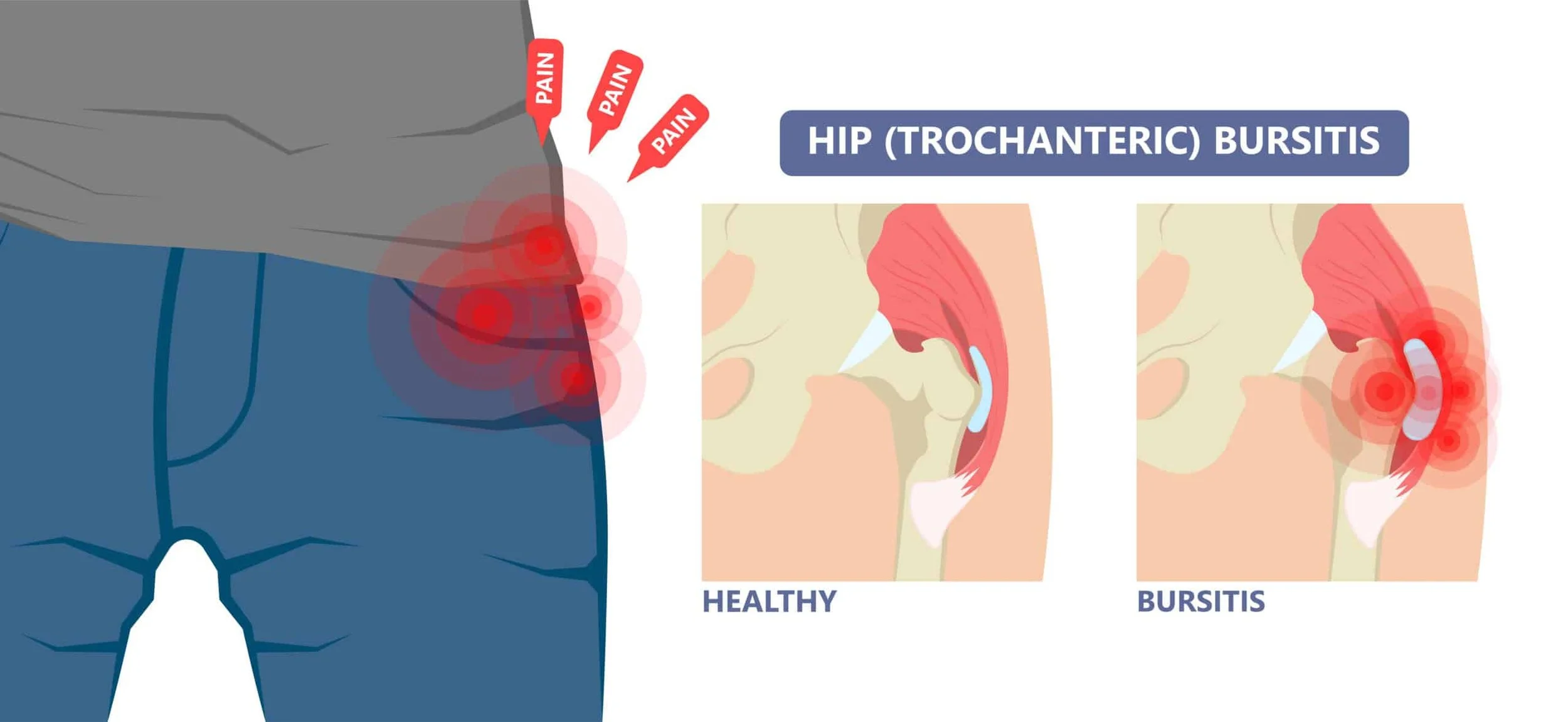
Severity: Mild to Moderate in most cases
Typical recovery time: GTPS can take 3 months or longer to fully resolve. Over 90% of people recover fully with conservative treatment
Can I keep running? Often yes at reduced intensity, but cambered roads, banked surfaces, and high mileage consistently worsen symptoms and should be avoided
What's Actually Happening: Greater trochanteric pain syndrome refers to pain over the greater trochanter, the bony prominence on the outer hip. For many years, this condition was called trochanteric bursitis and believed to be caused solely by inflammation of the bursa over the hip. More recent research has changed this understanding significantly, with MRI studies showing that trochanteric bursitis was actually an uncommon finding in isolation, and that gluteal tendinopathy, irritation, and degeneration of the gluteus medius and minimus tendons are the primary cause in most cases. The bursa, tendons, and iliotibial band all converge over the greater trochanter, and any or all of these can be involved. In runners specifically, the condition develops from abnormal compressive forces across the lateral hip caused by weak hip abductors and poor pelvic control during the stance phase of running. A dropping pelvis on the opposite side during single-leg stance, a Trendelenburg pattern, increases compressive load on the gluteal tendons and is a key biomechanical driver. While GTPS is most common in middle-aged women, it does occur in younger runners, footballers, and dancers due to high hip adduction forces during their sport.
How You Know It's This (Symptoms):
Aching or sharp pain directly over the outer bony prominence of the hip, sometimes radiating down the outer thigh but rarely below the knee
Pain that worsens when lying on the affected side at night, which is one of the most consistent and distinctive features
Pain reproduced by crossing the affected leg over the other when sitting, or by standing with the weight shifted onto the affected hip
Worsening with running, particularly on cambered or banked surfaces where one hip consistently drops lower than the other
Tenderness directly over the greater trochanter when pressed
What To Do Right Now:
Avoid positions that compress the outer hip, particularly lying on the affected side, crossing the legs, and standing with weight shifted entirely onto one hip
Reduce running on cambered roads or banked tracks, which force the hip into a position that increases compressive load on the tendons
Ice the outer hip for 15–20 minutes after activity if it feels warm or swollen
Avoid aggressive IT band stretching, particularly the crossed-leg standing stretch, as this places direct compressive load on the irritated tendons and can worsen symptoms
When to See a Professional:
Symptoms that don't improve after 4–6 weeks of activity modification and basic conservative measures
Pain that significantly disrupts sleep due to lying on the affected side
Corticosteroid injection is appropriate for cases with significant acute pain that is preventing engagement with physiotherapy. Injections show the greatest effect at around 6 weeks but often don't provide lasting relief on their own and are most useful when combined with physiotherapy
How to Treat It:
Load management: The most important early step is reducing the compressive load on the tendons. This means avoiding the positions described above alongside reducing running volume, particularly on uneven surfaces. This isn't passive rest but active load management — the tendons still need appropriate loading to heal, just not compressive loading in positions of hip adduction.
Progressive tendon loading: Structured physiotherapy with progressive gluteal tendon loading is the treatment with the best long-term outcomes for GTPS. One study found 60.5% of patients reported symptom resolution at 15 months with targeted physiotherapy. The program progresses from isometric hip abductor exercises in safe, non-compressive positions to progressive resistance work and eventually single-leg strengthening.
Hip abductor strengthening: Weak hip abductors are consistently identified as a central contributor to GTPS. Clamshells and sidelying hip abduction are appropriate early exercises since they load the glutes without placing the hip in a compressive position. Once these are well tolerated, progress to resistance band work and standing single-leg exercises.
Gait retraining: Addressing pelvic drop during running reduces the compressive forces that caused the problem in the first place. A physiotherapist can assess running mechanics and guide specific cues or drills to correct a Trendelenburg pattern during stance.
Shockwave therapy (ESWT): ESWT has demonstrated a 68.3% improvement in pain scores compared to control groups in research and is a well-supported option for cases not responding adequately to physiotherapy alone, with a low risk of adverse effects.
Corticosteroid injections: These provide significant short-term relief with the greatest effect at around 6 weeks, making them useful for managing acute pain and enabling engagement with physiotherapy. However, repeated injections carry a risk of tendon weakening over time and don't address the underlying biomechanical cause.
Positions and activities to avoid throughout treatment: Crossing legs when sitting, standing with one hip hitched out to the side, sleeping on the affected side without a pillow between the knees, and stretches that place the hip in adduction all increase compressive load on the tendons and slow recovery.
The Recovery Plan:
Week 1–4: Reduce running on uneven and cambered surfaces, avoid compressive positions throughout the day, begin isometric hip abductor exercises, and ice after activity. If pain is severe and preventing sleep or daily activity, a corticosteroid injection to manage acute pain can be discussed with a clinician.
Week 4–12: Progress to progressive resistance gluteal strengthening and begin addressing running mechanics. Light flat running is often compatible with this phase if pain stays manageable. ESWT can be introduced if symptoms haven't improved adequately by week 6–8.
Beyond 12 weeks: GTPS can take 3 months or longer to resolve and patience is genuinely important, since rushing the process or returning to high mileage before tendon capacity has been restored is the most common reason for prolonged symptoms. Athletes who complete a full progressive loading program see significantly better long-term outcomes than those who rely on injections alone.
