Tibial Stress Fractures
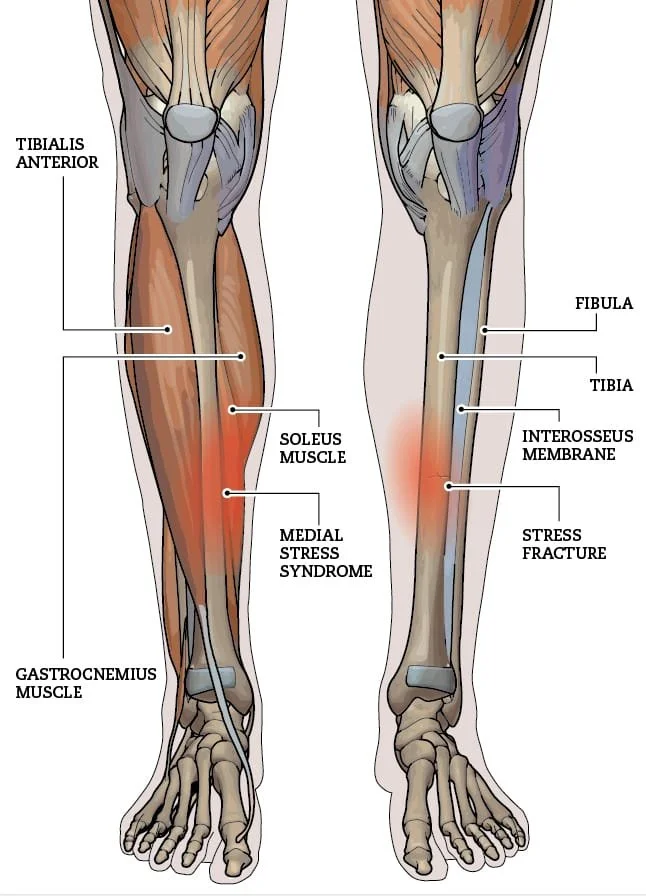
Severity: Severe
Typical recovery time: Most tibial stress fractures heal with 6–8 weeks of protected weight bearing, though some high-risk fractures require up to 4–6 months or even surgery
Can I keep running? No, treatment requires complete cessation of running for a variable period
What's Actually Happening: Stress fractures result from repetitive mechanical stress on bones, leading to an imbalance between bone breakdown and repair. When the bone can't keep up with the damage being done to it, hairline cracks develop. The tibial shaft is the most common site for stress fractures in long-distance runners, accounting for roughly 50% of all reported cases. Tibial stress fractures fall into two categories based on location: posterior fractures along the back of the shin, which are more common and carry a better prognosis, and anterior cortex fractures on the front of the shin, sometimes called "dreaded black line" fractures, which are notoriously slow to heal and more likely to require surgery. This is distinct from the tibial plateau stress fracture covered in the Knee section; that one involves the very top of the tibia near the joint, while this page covers fractures along the shaft of the shin bone itself.
How You Know It's This (Symptoms):
Tenderness localized over a specific spot on the shinbone, both with and without localized swelling
Pain that starts during a run and progressively worsens rather than easing up as you warm up
Pain that persists after stopping activity and may even be present at rest in more advanced cases
A clear, pinpoint tender spot on the bone; this is the key difference from shin splints, which cause diffuse tenderness over a broader area
A hop test: single-leg hopping on the affected side reproduces the pain
What To Do Right Now:
Stop running immediately and avoid all weight-bearing impact
Diagnosis may be delayed due to mild symptoms and unremarkable early X-rays, so an MRI is the most accurate imaging tool for confirming a stress fracture
See a doctor as soon as possible rather than waiting to see if it improves on its own
Poor nutrition and under fueling are strongly connected to decreased bone density and stress fractures; if you're not eating enough to support your training, this is worth addressing immediately alongside treatment
When to See a Professional:
Any localized, pinpoint shin pain that doesn't resolve with a few days of rest
Stress fractures should be included in the differential diagnosis whenever a runner presents with vague shin symptoms and has recently increased training frequency or intensity
Pain that is present at rest or at night, not just during activity
Tibial stress injuries have a high recurrence rate, so if you've had one before and feel similar symptoms returning, get it checked immediately rather than waiting
How to Treat It:
Pneumatic brace or CAM walker boot: Immobilization with a controlled ankle motion (CAM) walker boot or pneumatic leg brace is commonly used for higher-grade tibial stress fractures, particularly those with significant pain on walking. A randomized clinical trial found that athletes using a pneumatic leg brace showed a significant reduction in time to recommencing full activity compared to standard treatment. For military recruits and athletes with delayed union, these devices reduce tibial bending forces during daily activity without requiring crutches.
Cross training: Physical therapy and cross training with non-aggravating activities maintain flexibility, strength, and cardiovascular fitness during the rest period. Pool running with a flotation belt is the most specific option for maintaining running fitness without bone stress. Stationary cycling and swimming are the most commonly recommended alternatives. Optimal loading theory for low-risk tibial stress fractures suggests that non-impact cross training should continue throughout recovery, and that return to running should prioritize volume increases before speed increases.
Nutrition: Adequate calcium and vitamin D are critical for bone healing. Nutritional augmentation with calcium is specifically recommended in clinical management guidelines for tibial bone stress injuries. If you've had multiple stress fractures, a DEXA scan to assess bone mineral density and blood work to check vitamin D and parathyroid hormone levels are important steps, since low bone mineral density, poor nutritional status, and menstrual dysfunction all significantly increase the risk of tibial stress injury and recurrence.
Correction of contributing risk factors: Management of tibial bone stress injuries centers on identifying and correcting nutritional, metabolic, and biomechanical risk factors alongside activity rest. These are not secondary concerns — they are primary treatment targets since an unaddressed contributing factor makes recurrence highly likely even after full healing.
Gait retraining: Recurrent tibial stress injury is common, and gait retraining may be especially helpful in preventing further injury. Specific targets include increasing step rate, which reduces tibial impact loading with each stride, addressing a crossover gait pattern where the feet land across the midline, and reducing excessive hip adduction during stance which has been identified as a predictor of tibial stress injuries in female runners. Gait retraining should be incorporated slowly once return to running begins, to prevent transferring the load problem to another site.
Bone stimulation: Bone stimulation via electrical or ultrasonic impulses is used clinically for tibial stress fractures, particularly more stubborn anterior cortex fractures. An external bone stimulator may improve non-operative care and is worth discussing with your physician for higher-grade fractures, though the evidence base is still developing and current clinical literature notes that strong proof for this application is lacking.
Surgery: In athletes with high-grade tibial stress fractures refractory to conservative treatment, surgical fixation such as intramedullary nailing or tension band plating can be considered. Average return to running may be as high as 17 weeks in high-grade injuries, with some authors suggesting avoidance of high-impact activity for 4–6 months for anterior cortex fractures specifically.
The Recovery Plan:
Week 1–6: Complete rest from running and high-impact activity. Most tibial stress fractures heal with 6–8 weeks of protected weight bearing. Low-impact cross-training like swimming or cycling may be permitted depending on severity and your doctor's guidance.
Week 6–14: The expected time to return to sport following a tibial stress fracture is approximately 14 weeks on average, with female athletes typically requiring longer. Return to running is gradual and guided by both symptom resolution and imaging.
Beyond 14 weeks: Bone density at the fracture site may not return to baseline for up to 24 weeks after diagnosis, meaning re-injury risk stays elevated even after you feel completely recovered. Gait retraining to address underlying running mechanics is one of the most evidence-supported strategies for preventing recurrence.
