Shin Splints (Medial Tibial Stress Syndrome)
Severity: Mild
Typical recovery time: 2–6 weeks
Can I keep running? Light activity may be okay, but pushing through worsening pain risks progressing to a stress fracture
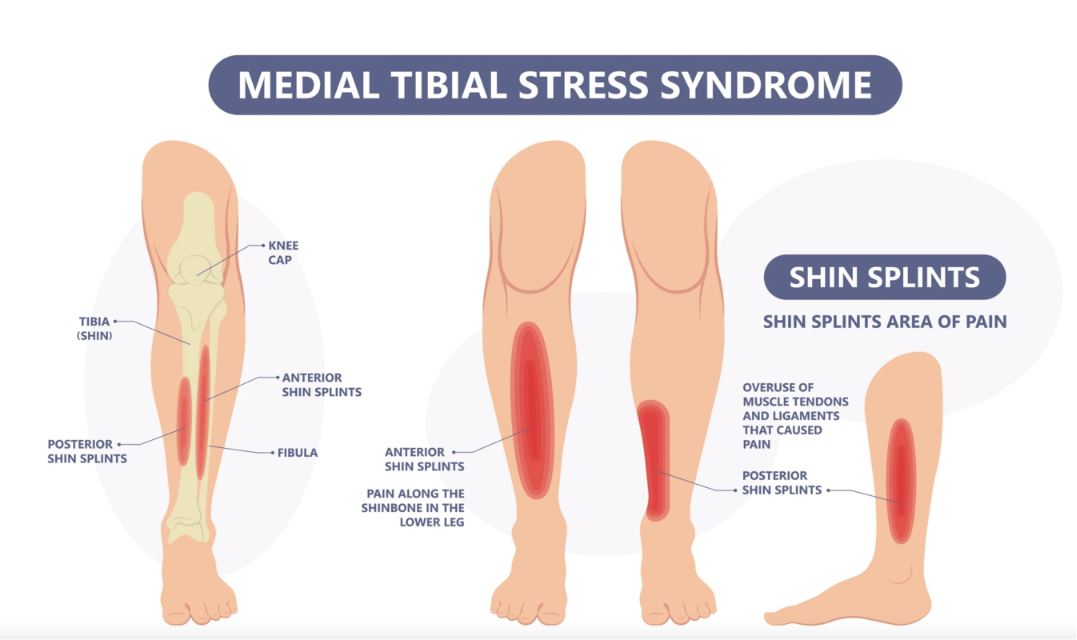
What's Actually Happening: Shin splints are one of the most common overuse injuries of the lower leg, typically seen in athletes who perform repetitive activities like running and jumping. It's most likely caused by overload of the medial tibia, essentially, the bone and surrounding tissue taking on more repetitive stress than they can recover from between sessions. It's considered an early stress injury in the same continuum as tibial stress fractures, meaning this is often the warning sign your body sends before something more serious develops. Large increases in training load, volume, or high-impact exercise put runners at higher risk, and risk factors include being female, having a previous history of shin splints, high BMI, certain foot mechanics, reduced hip rotation range of motion, and weakness or tightness in the calf muscles.
How You Know It's This (Symptoms):
Tenderness along the inner edge of the shin bone, typically in the middle to lower third of the leg
Pain along the inner shin that comes on during and after prolonged weight-bearing exercise
Diffuse tenderness or mild swelling over a broad area of the shin, rather than one specific pinpoint spot
Pain that's present at the start of a run and may ease slightly once warmed up, then return afterward
No sharp, localized point of pain (that pattern is more typical of a stress fracture and is worth distinguishing carefully)
What To Do Right Now:
Reduce training load and avoid the repetitive impact that's currently aggravating the area
Ice with cold packs for around 20 minutes after exercise
Over-the-counter pain relievers like NSAIDs or acetaminophen are commonly used for pain relief during this phase
Avoid running on hard or uneven surfaces while symptoms are present
When to See a Professional:
Pain that becomes increasingly localized to one specific spot rather than spread along the shin (distinction matters because the clinical features of shin splints need to be compared against tibial stress fractures or chronic exertional compartment syndrome to avoid misdiagnosis!)
Pain that doesn't improve after 2–3 weeks of reduced activity
Pain that's present even at rest, not just during exercise
Any concern that this could be progressing toward a stress fracture, since the two conditions exist on the same spectrum
How to Treat It:
Ice massage: Ice massage is the most widely used and recommended method for managing shin splint pain. Using a foam cup frozen with water, apply ice directly over the painful shin area in a circular motion for 5–10 minutes, one to three times daily. Compared to a standard ice pack, ice massage delivers more focused cold therapy directly to the periosteum of the tibia where the stress reaction is occurring.
Stretching and strengthening: Physical therapy focuses on exercises to gently stretch and strengthen the muscles around the shin. Calf stretching, both straight-knee and bent-knee, reduces the indirect traction forces placed on the tibial periosteum by tight posterior lower leg muscles. Lower extremity flexibility and strength training should be started to correct any muscular imbalances alongside load management.
Kinesiology taping: Kinesio taping applied to the lower leg using an I-strip stretched to 25% of its original length anchored at the anteromedial tibia has clinical support for reducing pain in MTSS. A study comparing kinesio taping to standard orthotics found comparable functional outcomes, making it a useful adjunct for runners who want to continue training at reduced load while managing symptoms.
Footwear and orthotics: Shoes should be replaced every 250–500 miles since most shoes lose up to 40% of their shock-absorbing capability at that point. For runners with excessive foot pronation or flat arches, prefabricated orthotics have been shown to reduce MTSS symptoms — a study in naval recruits showed prefabricated orthotics reduced MTSS incidence. Over-the-counter flexible or semi-rigid insoles are a reasonable first step before pursuing custom orthotics.
Massage: Physical therapists prescribe massage for the muscles around the shins as part of a comprehensive treatment program. Cupping therapy has been shown in a randomized clinical trial to produce significant pain reduction for MTSS, with results comparable to and in some measures better than the Graston technique. Soft tissue massage can also help manage the muscle tightness that contributes to periosteal loading.
Graston technique and instrument-assisted soft tissue mobilization (IASTM): IASTM applied to the posterior lower leg muscles has clinical support for MTSS management. A randomized trial comparing the Graston technique to cupping therapy found both produced significant improvements in pain scores and functional outcomes after three weeks, with four weekly sessions. These techniques are performed by a physiotherapist or sports medicine clinician.
Cross training: Swimming and cycling are appropriate during recovery. Avoid running on hills and uneven surfaces while symptomatic. Running on softer surfaces like grass or a track rather than concrete or asphalt also meaningfully reduces tibial loading.
Shockwave therapy (ESWT): Extracorporeal shockwave therapy has low-level evidence behind it for MTSS and is used clinically as an adjunct option when standard conservative measures haven't produced adequate improvement after several weeks.
The Recovery Plan:
Week 1–2: Rest combined with medication is recommended to improve symptoms and support a safe return after a period of reduced activity. Avoid the specific activities that aggravate the area and continue icing as needed.
Week 2–6: A progressive loading program designed to facilitate tissue healing and reduce the likelihood of recurrence is key during this phase, often paired with strengthening and flexibility work for the lower leg. In one documented case, a runner following this approach showed considerable improvement in both symptoms and pain levels over a span of six weeks, along with increased strength and flexibility.
Return to running: Prolonged rest beyond what's necessary isn't ideal for an athlete, so the goal is the shortest effective recovery period rather than defaulting to maximum rest. Return gradually, starting well below your previous mileage and watching closely for any return of pain.
