Chronic Exertional Compartment Syndrome (CECS)
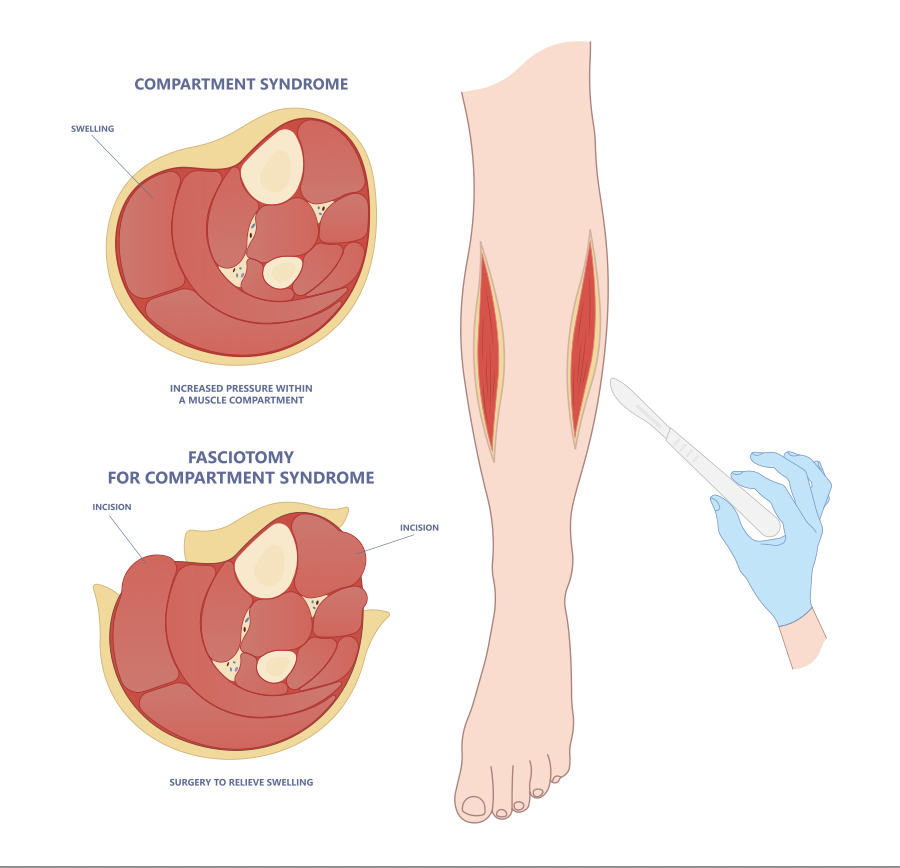
Severity: Moderate
Typical recovery time: Variable; those who want to return to full training often require surgery, after which most return to sport within 6 weeks
Can I keep running? No. The defining feature of this condition is that running causes it.
What's Actually Happening: Each muscle in your lower leg is enclosed in a tough, fibrous sheath called fascia. During exercise, muscles expand as blood flow increases; in most people, the fascia accommodates this expansion, but in CECS the compartment is too tight to allow it, causing pressure to build up inside. This rising pressure compresses nerves and blood vessels, producing the characteristic pain, tightness, and sometimes numbness. The exact cause isn't fully understood, but the condition is more common in young adult runners, with the median age of onset around 20 years old. It affects men and women at roughly equal rates. Research has found that 95% of CECS cases occur in the anterior or lateral compartments of the lower leg, which is why it's frequently mistaken for shin splints. The key difference is that CECS pain starts predictably after a consistent amount of running and resolves quickly with rest, while shin splint pain is more diffuse and present even without exercise.
How You Know It's This (Symptoms):
Pain, tightness, cramping, or a burning sensation that starts consistently after a certain distance, time, or intensity of running, not right from the start
Symptoms that affect both legs simultaneously in many cases
Numbness or weakness in the foot or lower leg during running in more significant cases
Pain that resolves within 15–30 minutes of stopping activity; this rapid resolution with rest is one of the most distinctive features of CECS
No significant pain at rest or during normal daily activity
What To Do Right Now:
Stop the run when symptoms start; pushing through does not help and can make the condition worse over time
Rest until symptoms resolve, which typically happens within 30 minutes
Do not self-diagnose and self-treat this one; CECS is commonly misdiagnosed as shin splints, and the treatments are meaningfully different
See a sports medicine doctor as soon as possible; proper diagnosis requires pressure testing before and after exercise, which can only be done in a clinical setting
When to See a Professional:
Any time you suspect this condition, an accurate diagnosis requires intracompartmental pressure testing before and after exercise, which cannot be replicated at home
If your doctor diagnoses shin splints but your symptoms start predictably mid-run and resolve quickly with rest, specifically ask about CECS and request pressure testing
If conservative management hasn't improved your ability to run after 6–8 weeks of consistent effort
How to Treat It:
Conservative options first: Nonsurgical treatment is worth trying before committing to surgery, though it has a limited success rate for runners who want to return to full training. Options include:
Gait retraining: Switching from a heel-strike to a forefoot running pattern has shown meaningful results in some runners — one study found that forefoot running training led to significant reductions in compartment pressure and allowed some runners to return to sport without surgery. This is currently one of the strongest non-surgical options available.
Activity modification: Reducing mileage, avoiding speed work, and switching to lower-impact cross-training may control symptoms without eliminating them entirely — this works better for runners with mild symptoms who aren't trying to compete at high levels.
Stretching and massage: These have limited evidence for directly treating CECS but may help manage surrounding muscle tightness and maintain range of motion during a period of reduced training.
Botulinum toxin injections: An emerging conservative option, one case study reported a female runner who was pain-free and jogging within two weeks of injection and remained symptom-free 14 months later, though the evidence base is still limited and this is not yet a standard treatment.
Surgical option: For runners who want to return to their previous training level, fasciotomy — a surgical procedure where small incisions are made to release the tight fascial sheath — has the strongest evidence of any available treatment. Studies report that anterior compartment fasciotomy allows 60–80% of runners to return to their previous level of training, with all patients in some studies returning to competition within 6 weeks. It's worth knowing that in roughly 10% of cases, symptoms return because the initial release was insufficient, requiring a second procedure.
The Recovery Plan:
If pursuing conservative treatment:
Week 1–4: Reduce or eliminate running. Begin gait retraining with a qualified physical therapist if pursuing the forefoot running approach; this requires proper guidance and a gradual transition, not an overnight change. Maintain fitness through swimming or cycling, which don't reproduce CECS symptoms.
Week 4 onward: Gradual return to running is guided by symptoms rather than a fixed timeline. If symptoms return at the same predictable point during runs, conservative management is likely insufficient and surgical consultation is worth pursuing.
If pursuing surgery:
Most runners are cleared for light jogging within 2–4 weeks post-surgery and return to full training within 6 weeks, though this varies by surgical approach and which compartments were released.
