Achilles Tendinopathy
Severity: Moderate
Typical recovery time: Mild cases improve in several weeks; more established cases typically take 3–6 months
Can I keep running? Often yes at reduced load. Complete rest actually slows tendon recovery since tendons need progressive loading to heal
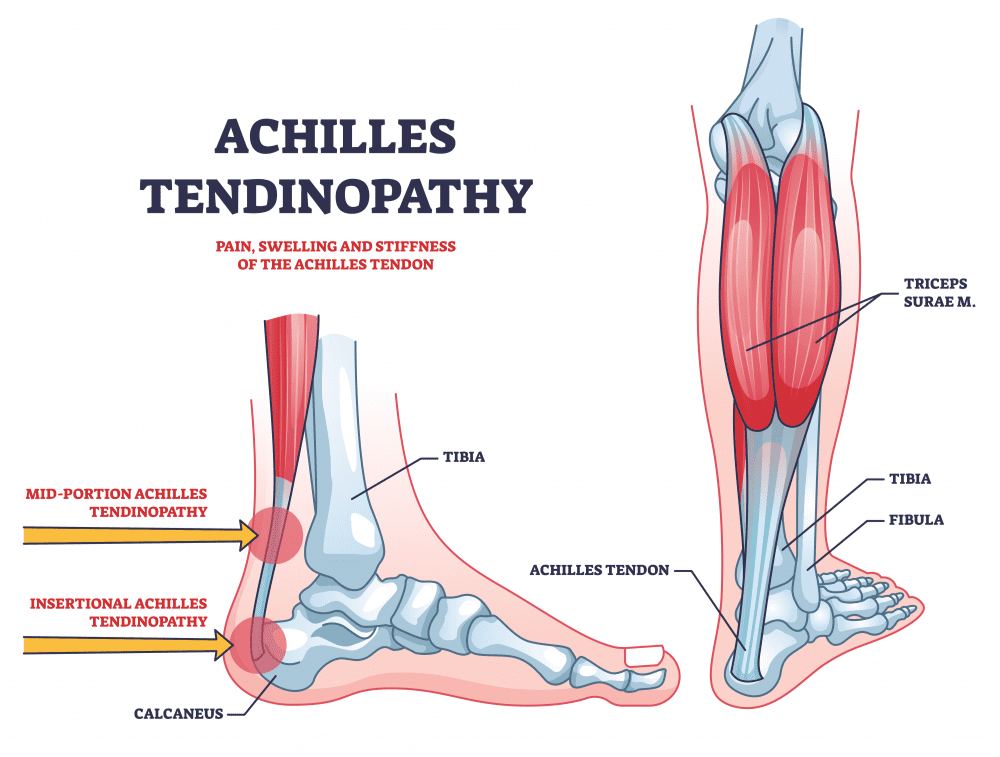
What's Actually Happening: The Achilles tendon connects your calf muscles to your heel bone and handles enormous forces during running, up to 6–8 times your body weight with every stride. Achilles tendinopathy is a painful overuse injury of this tendon that develops when cumulative loading outpaces the tendon's ability to repair itself. Among elite track and field athletes, 43% reported having current or prior Achilles symptoms, with the highest prevalence in middle-distance runners specifically, making this one of the most relevant injuries on this entire site. The condition exists on a spectrum: early on it involves inflammation and micro-tearing, which over time can shift into actual structural degeneration of the tendon tissue. The location matters too; pain at the mid-portion of the tendon, roughly 2–6 centimeters above the heel, has a better prognosis than pain directly at the heel bone insertion, which is a more stubborn variant with a different treatment approach.
How You Know It's This (Symptoms):
Morning stiffness at the back of the ankle that eases with movement; this is one of the hallmark signs of Achilles tendinopathy
Pain and tenderness along the back of the ankle, either at the mid-tendon or directly at the heel bone
Pain that worsens with increased training load, faster running, hill work, or sudden mileage increases
Possible thickening or a nodular bump along the tendon in more established cases
Pain that improves during a warm-up but returns after stopping activity (this on-off pattern is characteristic)
What To Do Right Now:
Reduce training load immediately
Avoid aggressive stretching of the Achilles in the early stages, despite being the instinctive response; aggressive stretching places compression and tension on an already irritated tendon and can actively worsen symptoms
Ice may temporarily reduce discomfort but does not address the underlying load tolerance issue; use it for symptom management, not as a primary treatment
Full recovery of tendon health requires complete rehabilitation, and symptom improvement does not mean tendon structure has fully recovered
When to See a Professional:
Pain that doesn't improve after 4–6 weeks of reduced load and consistent loading exercises
Pain directly at the heel bone insertion rather than the mid-tendon; insertional Achilles tendinopathy requires a modified treatment approach and professional guidance
Any sudden sharp pain or feeling of a snap in the tendon (could indicate a rupture and needs immediate evaluation)
Symptoms that have been present for several months without improvement, as shockwave therapy or other clinical interventions may be needed
How to Treat It:
Loading is the treatment: The single most important thing to understand about Achilles tendinopathy is that progressive tendon loading (not full rest) is the treatment with the highest level of evidence. About 80% of runners recover within a year with an exercise protocol alone. The key is that the tendon needs to be gradually stressed in a controlled way to stimulate repair and adaptation.
Heel raises: The cornerstone exercise. Begin with double-leg heel raises, progress to single-leg, then add load as tolerated. Eccentric heel drops, where you raise on both legs and lower slowly on one, are the most researched specific technique and have strong evidence behind them.
Heavy slow resistance training: Research over the past decade has shifted Achilles rehab toward heavy, slow resistance training rather than just eccentric exercises alone. Slower movements under significant load stimulate better tendon adaptation and have shown equal or better results than eccentric-only protocols.
Stretching — use carefully: Stretching alone rarely solves Achilles pain and can aggravate it early on. If used, gentle calf stretches are more appropriate after exercise than before, and should never be forced.
Shockwave therapy: Extracorporeal shockwave therapy (ESWT) is a non-invasive clinical treatment with good evidence — it involves a device sending shockwaves toward the tendon to break up scar tissue and promote healing. It's typically considered after 3 months of exercise therapy hasn't fully resolved symptoms, and requires a sports medicine or physiotherapy clinic.
Heel lifts: A small heel lift inside the shoe reduces the load on the Achilles during daily activity and running, useful early in rehab to manage symptoms while you begin loading exercises.
Footwear: Minimalist shoes or a sudden switch to zero-drop footwear significantly increases Achilles loading and is a common trigger for this injury. Avoid changing footwear dramatically during training without a long transition period.
The Recovery Plan:
Week 1–4: Reduce mileage significantly, cut out speed work and hill sessions entirely. Begin isometric calf exercises, which can reduce pain quickly and allow early loading. Avoid aggressive stretching.
Week 4–12: Progress to eccentric heel drops and heavy slow resistance calf work. Exercise therapy should be the primary focus during this phase; all patients are recommended to complete at least 3 months of exercise before considering other treatment options. Light, flat running is often compatible with this phase if kept at low intensity and volume.
Beyond 12 weeks: Gradual return to full training guided by symptoms. Meaningful improvement often takes several weeks to months of consistent loading work. Full tendon structural recovery can take up to a year; symptom improvement does not mean the tendon is fully healed, which is why re-injury is common when runners return too quickly.
