Sacroiliac Joint Dysfunction
Severity: Mild to Moderate in most cases
Typical recovery time: Most athletes see significant improvement within 8–12 weeks with structured physical therapy.
Can I keep running? Often yes at reduced intensity and volume. Avoid high-impact surfaces and asymmetrical loading like banked tracks and cross-country terrain until symptoms settle
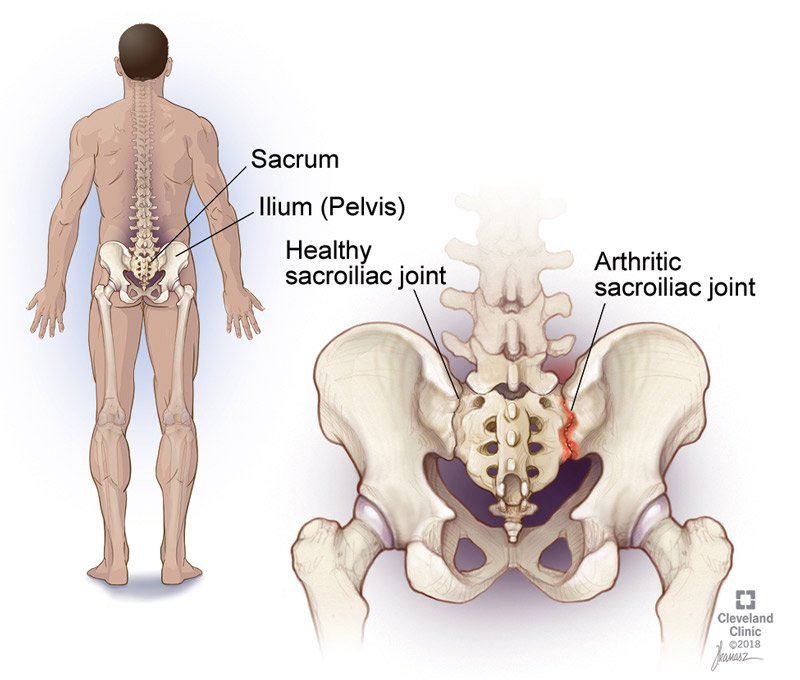
What's Actually Happening: The sacroiliac joint connects the sacrum, the triangle-shaped bone at the base of the spine, to the iliac bones of the pelvis on each side. Despite moving only a few millimeters in any direction, this joint plays a critical role in transferring weight between the upper and lower body and absorbing shock during movement. When it becomes inflamed, irritated, or moves abnormally, it produces significant pain in the lower back, buttock, and occasionally down the leg. In runners, the primary cause is repetitive strain, with each foot strike placing load through the SI joint, and over enough miles this can cause wear and inflammation, particularly when running mechanics are poor or when mileage increases too quickly. SI joint dysfunction is worth knowing about on this site specifically because a 2024 systematic review confirmed that it remains underdiagnosed and undertreated in endurance runners, meaning many athletes are managing this condition as lower back pain or sciatica without an accurate diagnosis. The condition affects 15–40% of chronic low back pain patients overall, suggesting it's far more prevalent than most runners realize.
How You Know It's This (Symptoms):
Aching or sharp pain localized to one side of the lower back or buttock, typically right at or just below the belt line on one side
Pain reproduced by direct pressure over the posterior superior iliac spine, the bony bump at the back of the pelvis on the affected side
Pain that can radiate into the buttock and upper thigh but typically doesn't extend below the knee, which helps distinguish it from true sciatica
Worsening with prolonged sitting, stair climbing, getting in and out of a car, or any asymmetrical loading that shifts weight onto one side of the pelvis
Symptoms that are often worse on one side and can shift sides in some cases
What To Do Right Now:
Reduce running volume and avoid asymmetrical loading activities like banked surfaces, single-leg drills, and heavily cambered roads
Apply ice to the affected SI joint area for 15–20 minutes after activity during the acute phase, transitioning to heat once acute inflammation settles
Avoid prolonged sitting without lumbar and pelvic support
A temporary SI joint support belt can help stabilize the joint during daily activity and reduce acute symptoms while rehabilitation begins
When to See a Professional:
Any radiating pain below the knee, significant numbness, or leg weakness alongside SI joint pain, since these suggest nerve involvement that needs proper evaluation to distinguish from lumbar disc problems
Symptoms that don't improve after 2–3 weeks of load reduction and basic conservative care
An accurate diagnosis of SI joint dysfunction requires clinical assessment using provocation tests, and sometimes a diagnostic injection to confirm the joint as the pain source. Self-diagnosing and treating SI joint dysfunction without professional input risks treating the wrong condition entirely
Runners who have had multiple episodes of lower back pain that shifted sides or didn't respond to standard lumbar treatments should specifically ask about SI joint assessment
How to Treat It:
Exercise therapy as the primary treatment: Exercise therapy demonstrates superior long-term outcomes compared to manual therapy alone for SI joint dysfunction, though combined approaches provide the fastest initial relief. A structured progressive program targeting core stabilization and hip strengthening is the foundation of evidence-based treatment.
Core stabilization: The SI joint's stability depends on both the passive support of its ligaments and the active support of surrounding muscles. Core stabilization exercises that target the deep stabilizers, including the transversus abdominis, multifidus, and pelvic floor, are the cornerstone of rehabilitation. Bird dogs, dead bugs, and progressive planks are appropriate early exercises that load the core without placing asymmetrical stress on the SI joint.
Glute and hip strengthening: Weak glutes and hip abductors increase the load through the SI joint during running by reducing pelvic stability during the stance phase. Glute bridges, clamshells, and sidelying hip abduction are important components alongside core work.
Manual therapy: Joint mobilization and manipulation of the SI joint by a physiotherapist or chiropractor provides meaningful short-term pain relief and improves joint mobility, making it easier to engage with exercise rehabilitation. In one documented case study using an evidence-based algorithmic approach, manual therapy combined with exercise produced complete resolution of SI joint pain with the patient returning to full function within one month.
SI joint support belt: A sacroiliac support belt worn during running can reduce joint stress and provide symptom relief during the return to training phase. It's useful as a short-term adjunct rather than a long-term solution.
Gait retraining: Addressing asymmetries in running mechanics reduces the repetitive uneven loading on the SI joint that caused the problem. Increasing step rate, reducing pelvic drop, and correcting cross-body arm swing are all relevant targets depending on individual movement patterns.
Corticosteroid injections: For cases not responding to conservative measures, an image-guided SI joint injection can provide both diagnostic confirmation and therapeutic relief. Injections are most effective when combined with active rehabilitation rather than used as standalone treatment.
The Recovery Plan:
Week 1–2: Reduce running load, apply ice then heat, begin SI support belt if helpful, and start gentle core activation exercises. Avoid prolonged sitting and asymmetrical loading throughout the day.
Week 2–8: Progress through a structured core stabilization and hip strengthening program. Manual therapy from a physiotherapist alongside exercise provides the fastest initial relief. An 8-week progressive protocol achieves significant improvement in 78% of compliant patients, with neuromuscular adaptation continuing through weeks 6–12.
Beyond 8 weeks: Return to full training gradually with continued attention to running mechanics and core strength maintenance. SI joint dysfunction has a high recurrence rate when the underlying weakness and movement patterns that caused it aren't addressed long-term. Cross-training by mixing up workouts helps prevent overuse recurrence.
