Plica Syndrome
Severity: Mild to Moderate
Typical recovery time: Several weeks to a few months
Can I keep running? Often yes at reduced intensity
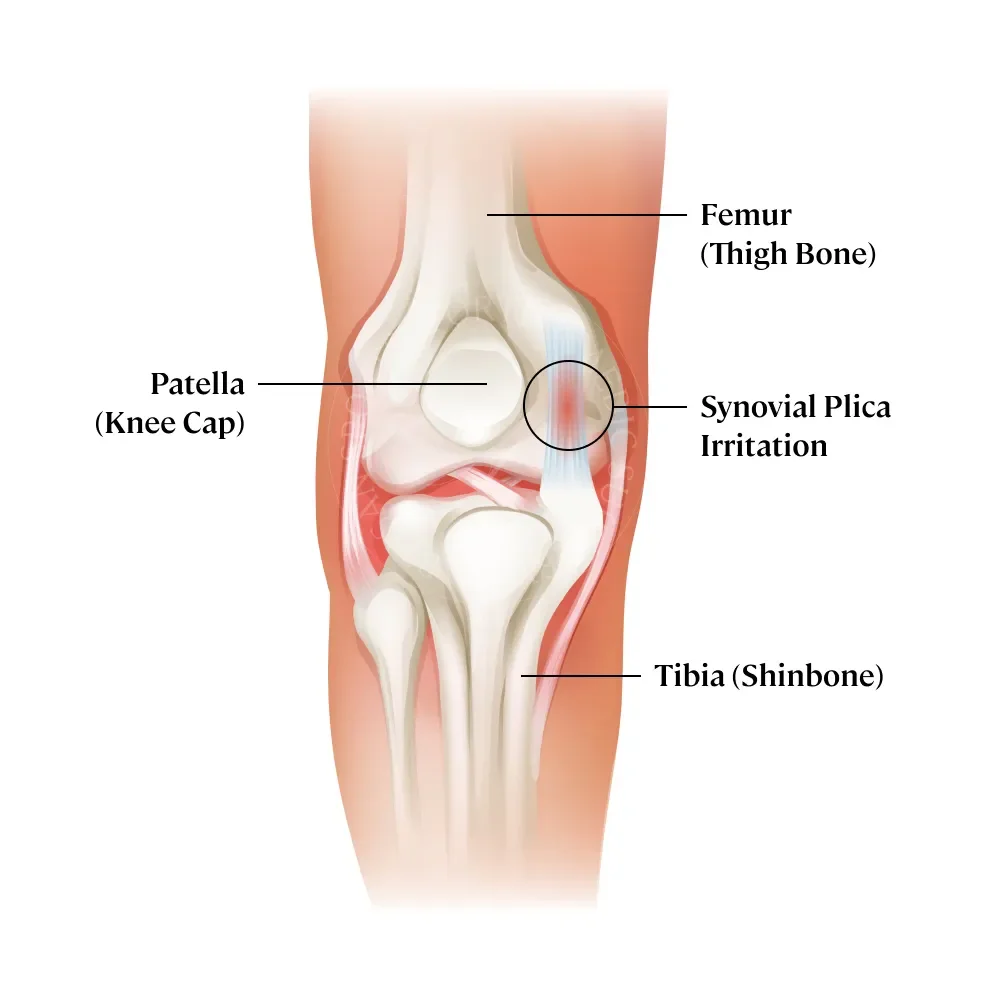
What's Actually Happening: The knee joint is lined with a membrane called the synovium, which can have fold-like remnants left over from fetal development called plicae. Most people have these folds without any issue, but plica syndrome occurs when one of them becomes irritated, inflamed, or thickened. Most people have four folds in each knee, and it's usually the one in the middle that becomes irritated, causing pain, swelling, and instability. The medial plica on the inner side of the knee is most often the source of symptoms. People who repetitively bend and straighten their knees, like runners and cyclists, are most susceptible. The fibrotic plica can cause pain and a popping sensation as it rubs across the femur or the underside of the kneecap with movement. One important note: plica syndrome shares several symptoms with runner's knee, including pain with stairs, squatting, and prolonged sitting, which is part of why it's so commonly misdiagnosed.
How You Know It's This (Symptoms):
Medial knee pain, clicking, and swelling, especially during activity
A clicking or snapping sensation in the knee, along with discomfort during certain movements
A popping sensation when bending the knee, particularly when squatting or going up and down stairs
Symptoms that started after either a direct knee injury or after a period of prolonged, strenuous exercise
What To Do Right Now:
Rest from strenuous or precipitating activities is the standard first step in treatment
Avoid deep squats and repetitive knee bending that triggers clicking or pain
Icing the knee can help manage symptoms in the early stages
If symptoms persist beyond a few weeks or start interfering with daily life, targeted physiotherapy may be needed for full recovery
When to See a Professional:
Persistent knee pain, swelling, clicking, catching, or a feeling of instability in the knee
Symptoms that don't improve after several weeks
Any uncertainty about the diagnosis, since plica syndrome closely mimics other knee conditions and needs proper evaluation to rule those out
If symptoms fail to settle after 3–6 months of non-surgical treatment, your doctor may discuss surgical options
How to Treat It:
Activity modification and cross training: Reducing or eliminating activities that repeatedly flex and extend the knee is the most important early step. Swimming is particularly well suited since it maintains cardiovascular fitness and joint mobility without the repetitive knee flexion of running. Focusing on upper body training can also help maintain overall fitness during the recovery period.
Ice: Ice packs applied to the inner knee after activity reduce inflammation and pain during flare-ups. Ice massage applied directly over the plica region is another practical method for localized symptom management.
Quadriceps strengthening: Building quad strength is a central part of plica syndrome rehabilitation since stronger quads reduce the mechanical stress placed on the inflamed plica during movement. Straightening exercises and step-ups are appropriate early options that don't require deep knee bending.
Hamstring flexibility: Tight hamstrings increase the compressive forces acting on the knee, which can worsen plica irritation. Consistent hamstring stretching alongside quad strengthening is a well-supported component of conservative management.
Active release technique and foam rolling: Active release techniques applied by a physiotherapist or sports chiropractor target the tight plica tissue and surrounding structures directly. Foam rolling the quad and hamstring regions reduces surrounding muscle tension and is a practical tool for daily maintenance. A foam roll placed under the knee in a relaxed position can also gently stretch the posterior knee structures.
Manual therapy: A physiotherapist or chiropractor can palpate the plica directly on the medial side of the kneecap at the joint line — this is both a useful diagnostic tool and a guide for targeted soft tissue work. Hands-on treatment of the plica and surrounding tissue complements the exercise program and can speed symptom resolution.
Corticosteroid injection: A corticosteroid injection into the affected plica region can provide significant short-term pain relief and reduce the inflammation that is perpetuating the mechanical irritation. This is an appropriate intermediate step for cases not responding to 4–6 weeks of conservative measures.
Surgery: Arthroscopic removal of the inflamed plica is considered only after conservative treatment has genuinely failed over several months. Most cases resolve with conservative measures — one study found 49 of 55 patients treated conservatively returned to their prior activity level without recurrence.
The Recovery Plan:
Week 1–2: Rest from aggravating activity, ice as needed, and avoid deep knee bending. Anti-inflammatory medication can help reduce pain and swelling during this stage if recommended by a doctor.
Week 2–8: Begin physical therapy to strengthen and stretch the muscles and soft tissues around the knee. Exercises that increase knee extensor strength, along with flexibility work for the quads, hip adductors, calves, and hamstrings, are commonly recommended.
Beyond 8 weeks: Recovery time varies based on the treatment approach but typically takes several weeks to months. One study found that 49 of 55 patients treated conservatively returned to their prior activity level without symptoms returning, and the remaining patients also returned to baseline, though with occasional, tolerable symptoms. Most patients recover fully with conservative measures, with surgery considered only if those strategies fail over time.
