Chondromalacia Patellae
Severity: Mild to Moderate
Typical recovery time: Mild cases improve in 4–6 weeks; persistent cases take 3–6 months with consistent physical therapy
Can I keep running? Unlikely, high mileage, and hill work typically aggravate it. Reduce intensity and avoid surfaces that worsen symptoms
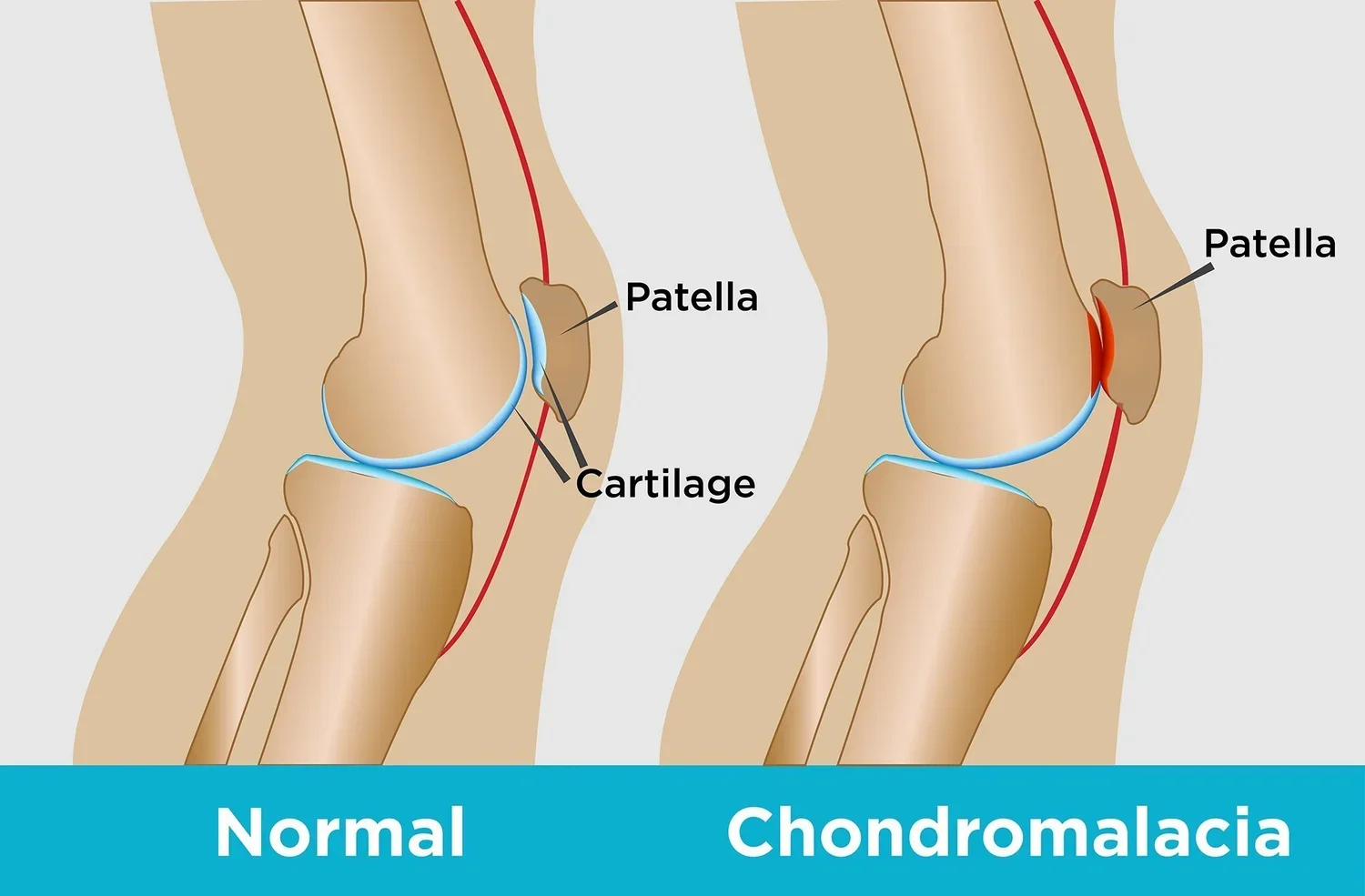
What's Actually Happening: The kneecap is lined with the thickest cartilage in the entire body, designed to help it glide smoothly over the knee as you bend and straighten your leg. In chondromalacia patellae, this cartilage softens, fissures, and begins to break down, causing the kneecap to rub against the thigh bone rather than glide cleanly over it. It's caused by a combination of factors, including abnormal kneecap movement, muscle imbalances, overuse, and anatomical variations in how the knee is built. It's worth knowing that this is not the same as Runner's Knee (PFPS), which is about how the kneecap tracks and moves, while chondromalacia involves actual structural changes to the cartilage itself, though the two conditions share similar symptoms and treatment approaches. Unlike the cartilage damage seen in arthritis, chondromalacia damage can often heal with proper conservative treatment.
How You Know It's This (Symptoms):
Pain and tenderness directly under or around the kneecap that increase after sitting for a prolonged period, using stairs, or getting up from a chair
A grating, grinding, or clicking sensation when bending or straightening the knee
Pain that builds during or after running, especially on hills or uneven surfaces
Swelling and a sensation of the kneecap catching or not moving smoothly
What To Do Right Now:
Reduce mileage and avoid activities that directly load the kneecap — deep squats, stairs, and downhill running, especially
Ice for 15–20 minutes after activity to control inflammation
Patellar taping using the McConnell taping technique or a patellar stabilizer brace can improve alignment and reduce pain during activity
Allow the initial inflammation to subside before pushing back into full training
When to See a Professional:
Symptoms that don't improve after 4–6 weeks of reduced activity and strengthening
Significant swelling or a feeling of the knee locking or giving way
Pain severe enough to affect normal walking
If MRI or imaging is needed to confirm the diagnosis and rule out other causes of cartilage damage, a physician referral is necessary
How to Treat It:
Exercise therapy: Evidence consistently shows that exercise therapy is more effective than no exercise for chondromalacia patellae. Closed kinetic chain exercises, where the foot is in contact with the ground, are the cornerstone of rehabilitation — terminal knee extensions with a resistance band and step-ups are particularly effective for improving patellar alignment and reducing pain. Hip strengthening and a coordination program are important components alongside direct quad work.
Patellar taping: Patellar taping using the McConnell technique appears to reduce pain and improve function during both daily activities and rehabilitation exercise for chondromalacia. The mechanism involves producing an inferior shift in patellar displacement, which increases the contact area and reduces localized pressure. Taping is most effective when combined with exercise therapy rather than used alone.
Foam rolling: Foam rolling the quads, hamstrings, and hip flexors reduces the tension these muscles place on the patellofemoral joint indirectly. Foam rolling as a recovery tool has been shown to improve flexibility and reduce muscle soreness, making subsequent exercise more productive. Avoid rolling directly over the kneecap.
Ice: Applying ice to the knee after activity reduces local inflammation and pain. Most effective during the acute phase or following flare-ups. Apply for 15–20 minutes after any activity that aggravates the knee.
Cross training: Cycling and swimming are appropriate alternatives during the symptomatic period since both unload the patellofemoral joint significantly compared to running. Avoid deep squats, stair climbing, and downhill running which place the highest compressive loads on the underside of the kneecap.
Orthotics and footwear: Patellar realignment bracing is another option alongside taping, providing external mechanical correction of patellar tracking. Supportive footwear that controls overpronation may reduce the indirect load on the patellofemoral joint, though evidence for orthotics specifically in chondromalacia is less robust than for PFPS more broadly.
Surgery: Reserved for patients with persistent, disabling symptoms after 6–12 months of dedicated conservative treatment. Most runners recover functional pain-free movement without surgical intervention.
The Recovery Plan:
Week 1–2: Reduce or eliminate high-impact activity, ice consistently after any exercise, and begin a gentle range of motion work. Avoid deep knee bending entirely.
Week 2–6: Begin physical therapy focused on quad strengthening, hip strengthening, and improving kneecap control. Physical therapy addresses how the kneecap moves over the joint, which is the root of the problem. Side-lying leg raises, terminal knee extensions, and step-ups are commonly used exercises.
Week 6 onward: With consistent physical therapy and activity modification, most patients see significant symptom improvement within 3–6 months. Full cartilage regeneration is unlikely in more advanced cases, but pain-free running is excellent for most people. Surgery is reserved for patients with persistent, disabling symptoms after 6–12 months of dedicated conservative treatment.
