Patellar Tendinopathy (Jumper's Knee)
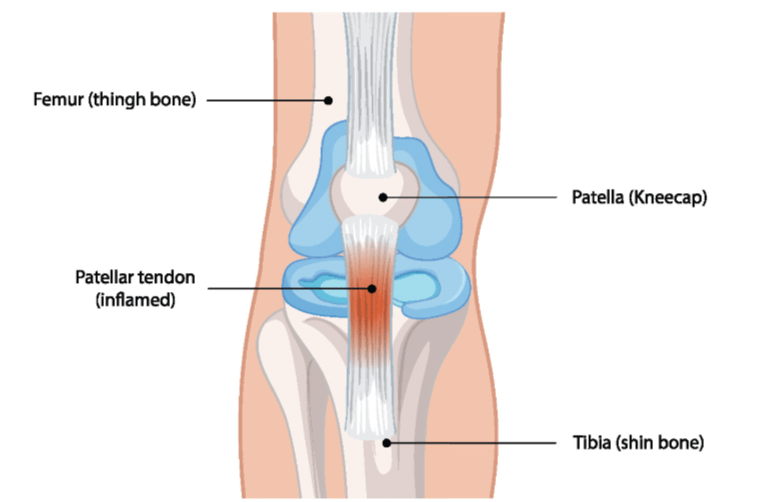
Severity: Moderate
Typical recovery time: Highly variable — mild cases improve in weeks, but more established cases can take several months to fully resolve
Can I keep running? Usually, yes, but at a lower intensity.
What's Actually Happening: The patellar tendon connects your kneecap to your shinbone, and jumper's knee develops when repeated stress on it exceeds what the tendon can recover from between sessions. This repeated stress causes tiny tears in the tendon, and without enough recovery time, the tendon weakens. Your body responds by thickening the tendon as it tries to heal. Early on, this is more of an inflammatory response, but with ongoing stress, it shifts into longer-term tendon degeneration. It's most common in sports involving a lot of jumping, but training more than 20 hours a week of high-impact activity, sudden increases in training intensity, and tight quad or hamstring muscles all raise the risk.
How You Know It's This (Symptoms):
A low, dull ache directly below the kneecap that's tender even to light touch
Pain that gets worse when using or moving the knee, especially when straightening it
Stiffness that makes it harder to bend or straighten the knee fully
Symptoms that start gradually and worsen over time rather than appearing suddenly
What To Do Right Now:
Reduce the volume and frequency of high-load activities that aggravate it, like speed work, hill repeats, or anything involving repetitive jumping
This doesn't mean total rest — complete rest can actually weaken the tendon further, so the goal is modifying load, not eliminating it
Ice after activity
If pain doesn't improve with a few days of rest and basic care, it's worth getting it checked out rather than waiting
When to See a Professional:
Pain that doesn't improve on its own after a few days of rest and basic at-home care
Pain or stiffness that's limiting your ability to walk normally
Symptoms that continue for several weeks despite reducing training load
Any sense of significant weakness or instability in the knee, which could indicate something beyond simple tendinopathy
How to Treat It:
Progressive loading: Loading is the treatment. The most effective evidence-supported approach is a structured strengthening program that progresses the tendon from low-load isometric work through to high-load heavy slow resistance training and ultimately sport-specific loading. The most effective specific treatment to date is a strengthening program with eccentric drop-squat exercises, and more recent research has confirmed that heavy slow resistance training produces equal or better results than eccentric-only programs.
Cross friction massage: Firm, pressured cross friction massage applied directly to the patellar tendon, either in clinic by a physiotherapist or at home using two fingers, serves to restore normal healing in the involved tissue by counteracting the degenerative changes in the tendon. Instrument-assisted soft tissue mobilization achieves a similar effect with greater precision. This manual therapy approach is not more beneficial than therapeutic exercise alone, but it is an appropriate and useful adjunct alongside the strengthening program.
Foam rolling: Rolling the quads and hamstrings reduces the indirect tension placed on the patellar tendon by tight surrounding muscles. Muscle imbalances in the extensibility and tone of the quads, hamstrings, and calf musculature should all be addressed. Use a harder foam roller or even a PVC pipe on the quads if the standard roller doesn't provide enough pressure.
Shockwave therapy: Extracorporeal shockwave therapy appears to be a useful adjunct to the eccentric and heavy slow resistance strength protocol in the treatment of chronic patellar tendinopathy. Research consistently supports its effectiveness and it is typically recommended after the known conservative treatments have had adequate time to work. It is most effective when combined with a structured rehabilitation program rather than used as a standalone treatment. Most clinics recommend at least three sessions at weekly intervals as a starting point.
Footwear: Shoes with a lower heel-to-toe drop may reduce patellar tendon loading since running in a standard shoe with a high heel-to-toe drop is similar biomechanically to running downhill. If experimenting with lower-drop shoes, do so gradually since the load shifts to the forefoot, ankle, and Achilles — swapping one overuse injury for another is a real risk if the transition is too fast.
PRP injections: Platelet-rich plasma injections, which involve injecting a concentrated form of platelets from your own blood into the tendon, have emerging evidence as a treatment for chronic patellar tendinopathy. Multiple PRP injections are a suitable option when conservative loading programs haven't produced adequate improvement, and systematic reviews have found favorable outcomes for this approach.
Cross training: Cycling and swimming maintain fitness without loading the patellar tendon through the range of motion that provokes symptoms. The elliptical may still aggravate symptoms depending on degree of knee flexion — test cautiously. Avoid deep squats, stair climbers, and plyometric work until the tendon is tolerating progressive loading well.
The Recovery Plan:
Week 1–2: Reduce high-load activity significantly. Focus on relative rest rather than complete stoppage — the most effective approach is a progressive rehab plan that allows the injury to calm down first before gradually building tendon strength.
Week 2–8: Begin a structured loading program — researchers in this field have proposed heavy, slow strength training for the tendon, which has shown better results than older approaches that focused only on one specific type of muscle contraction. Some discomfort during these exercises is normal as long as it settles within 24 hours afterward.
Beyond 8 weeks: Minor cases often resolve within 2–6 weeks with rest and physical therapy, but more established cases can take 3 months or longer. Be aware that the full rehab process can be slow, and patience with the process leads to better outcomes than rushing back.
