Knee Ligament Sprains (MCL, LCL & ACL)
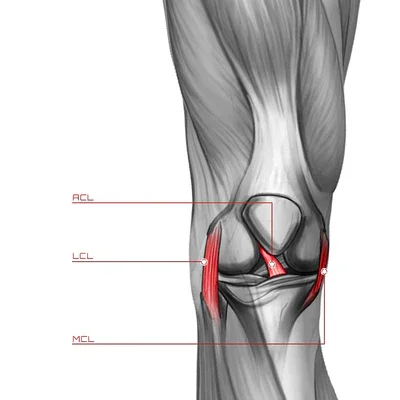
Severity: Mild to Severe, depending on which ligament/degree of injury
Typical recovery time: 1–3 weeks for mild sprains; 4–6 weeks for moderate; several months for severe or ACL tears
Can I keep running? For mild MCL or LCL sprains, light activity may be okay. Any feeling of the knee "giving way" means stop immediately
What's Actually Happening: Your knee is stabilized by four main ligaments. The MCL runs along the inside of the knee, connecting the thigh bone to the shin bone, while the LCL runs along the outside, connecting the thigh bone to the calf bone; both control side-to-side stability. The ACL sits inside the joint and controls front-to-back and rotational stability, keeping the thigh bone and shin bone properly aligned during twisting movements. When any of these ligaments is stretched beyond its limit from a sudden change in direction, awkward landing, or impact, it sprains or tears. Ligament injuries are graded 1 through 3: Grade 1 is a mild stretch with the ligament still intact, Grade 2 is a partial tear with some instability, and Grade 3 is a complete rupture with significant instability. In runners specifically, MCL sprains can also develop gradually from biomechanical issues like overpronation or weak glutes, causing the inside of the knee to take more strain than it should over time.
How You Know It's This (Symptoms):
MCL (inner knee):
Pain and tenderness directly over the inside of the knee, directly over the ligament
Swelling and a feeling of instability or looseness in the joint
LCL (outer knee):
Pain along the outside of the knee, distinct from IT band pain, which tends to sit higher
Tenderness over the outer knee with possible swelling and instability
ACL (inside the joint):
Often accompanied by a popping sound at the moment of injury
Significant swelling that develops quickly, usually within hours
A clear feeling that the knee is unstable or "giving way," especially with rotational movements
What To Do Right Now:
Stop running immediately — unlike most overuse injuries, ligament sprains from a specific incident need to be evaluated before returning to activity
Apply ice for 15–20 minutes every 2–3 hours in the first 48 hours to control swelling
Keep weight off it if walking causes significant pain — crutches may be needed for Grade 2 or 3 injuries
See a doctor or athletic trainer as soon as possible; an accurate grade diagnosis changes the treatment and recovery plan
When to See a Professional:
Any ligament injury where the knee feels unstable, gives way, or locks up
Significant swelling that develops within hours of the injury
Pain severe enough to make walking difficult or to bear weight on the knee
Any suspected ACL involvement; this one should always be professionally evaluated
How to Treat It:
Bracing: A hinged knee brace limits unwanted movement and provides mechanical support while the ligament heals. For MCL and LCL injuries specifically, bracing is commonly used in clinical practice to support the joint during early rehabilitation and facilitate range of motion training, particularly for Grade 2 injuries. Functional knee bracing after ACL reconstruction is also used to protect the graft during the early healing period, though the evidence for and against its use remains somewhat mixed. A brace helps you feel safer during recovery but does not restore strength, timing, or coordination on its own.
Taping: Sports taping of the knee provides support and protection both in the early stages after injury and when returning to full training. Patellar taping has also been used as an adjunct in MCL sprain rehabilitation. Taping is most effective when combined with strengthening work rather than used as a standalone treatment.
Progressive strengthening: Physical therapy is the cornerstone of recovery for all knee ligament injuries. A structured program restores strength, range of motion, and neuromuscular control progressively. Progression should match both the specific ligament injured and the stage of healing — generic advice that doesn't differentiate between an MCL sprain and an ACL tear often misses this important nuance.
Cross friction massage: In the early acute stage, massage directly over the injured ligament should be avoided. Once the ligament is in the healing phase, light cross-friction massage may help manage persistent pain and tissue quality. Instrument-assisted cross fiber massage has been shown in research to accelerate the return of biomechanical properties in healing ligaments by increasing tissue perfusion and altering microvascular morphology in the surrounding area.
Cross training: Cycling and swimming are appropriate during recovery since neither places significant rotational or impact load on the injured ligament. Athletes and active individuals are advised to use low-impact alternatives to avoid regression during healing. Avoid movements that place direct strain on the injured ligament until strength and stability are adequately restored.
Proprioception and neuromuscular retraining: Ligament injuries also damage the nerve endings that provide joint position sense, leaving the knee vulnerable to re-injury even after structural healing. Balance drills, wobble board work, and perturbation training specifically retrain this neuromuscular control and are an important part of rehabilitation alongside strengthening.
Surgery decision: Most MCL and LCL injuries don't require surgery and respond well to conservative management. ACL decisions are more complex and should involve a thorough discussion with an orthopedic surgeon about activity level, stability, and goals. The Cross Bracing Protocol, a newer conservative ACL management approach involving knee immobilization at 90 degrees in a brace for 4 weeks followed by progressive range of motion, has shown MRI evidence of ACL healing in a meaningful proportion of cases and is an emerging option worth discussing with your surgeon.
The Recovery Plan:
Grade 1 (Mild sprain) — Week 1–3:
Recovery time is typically 4–6 weeks for MCL and LCL sprains, depending on severity, but Grade 1 sprains often resolve within 1–3 weeks with rest, ice, and light range of motion work. Begin gentle quad and hamstring strengthening as pain allows.
Grade 2 (Partial tear) — Week 1–6:
Most Grade 2 MCL and LCL tears heal with nonsurgical treatment, though recovery takes several weeks. A brace may be recommended to protect the knee while healing. Physical therapy focusing on strength and stability is essential before returning to running.
Grade 3 (Complete tear) / ACL:
Partial ACL tears may be treated non-operatively with progressive physical therapy and rehabilitation, with recovery taking at least 3 months. Complete ACL ruptures are a different situation entirely; a minor ACL injury can heal within a few weeks with minimal intervention, but a partial tear could take six months or longer with rigorous physical therapy. Surgery decisions for complete ACL tears should be made with an orthopedic specialist based on your activity level and knee stability.
