Osgood-Schlatter Disease
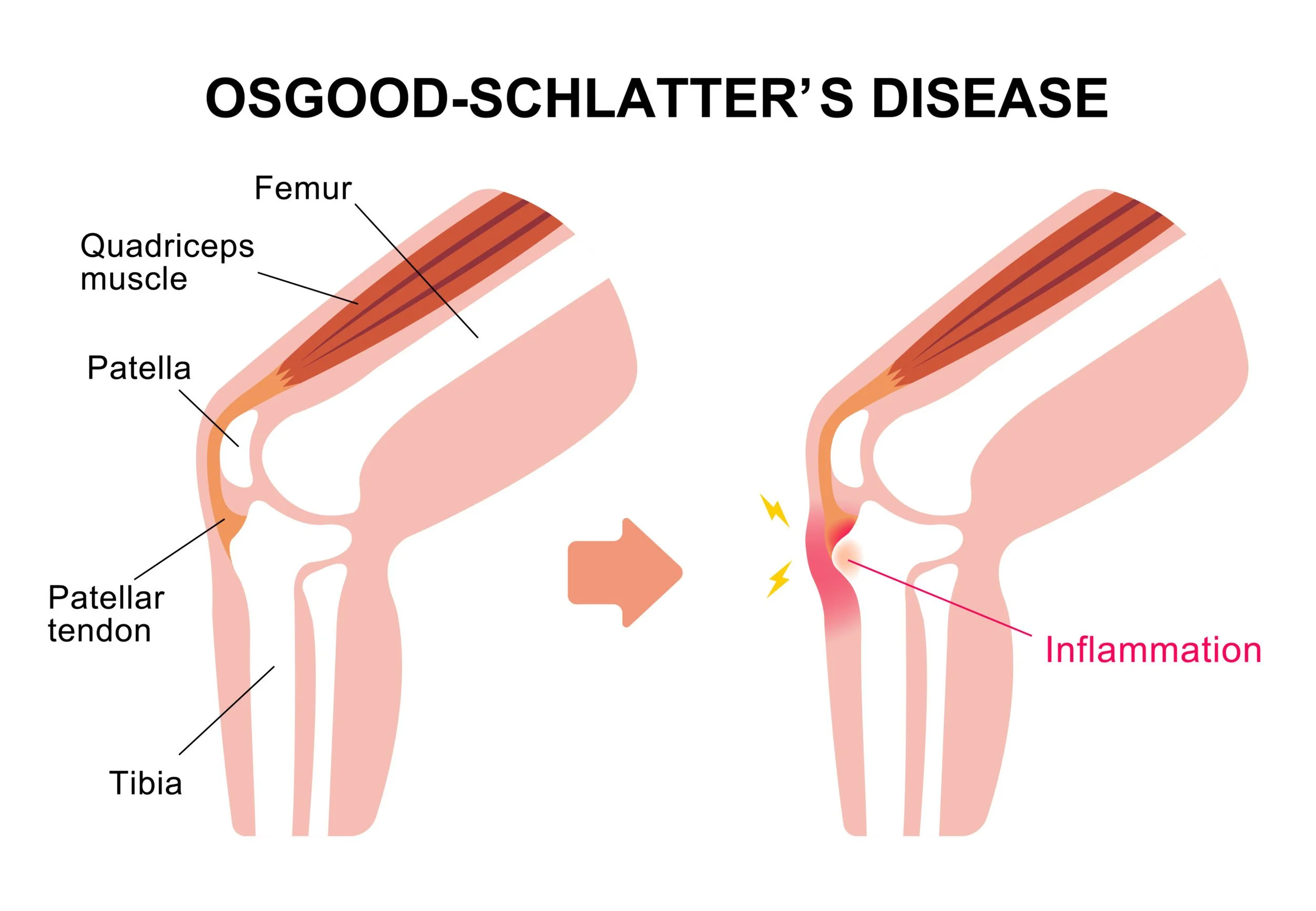
Severity: Mild
Typical recovery time: A few weeks to a few months
Can I keep running? Yes, if pain is tolerable, in fact, continuing activity within a pain limit isn't dangerous and helps maintain quad and hamstring strength, which supports recovery
What's Actually Happening: Osgood-Schlatter is one of the most common causes of knee pain in adolescent athletes, hitting during the growth spurt years — roughly ages 10–15 for boys and 8–13 for girls. It develops in young people whose bones are still growing, especially in sports involving lots of running and jumping. During this growth stage, the tendon connecting your kneecap to your shin pulls repeatedly on the growth plate at the top of the shin bone, leading to small tears, irritation, and inflammation right at that attachment point. This connection point is especially vulnerable during growth spurts since the bone is growing while the tendon is relatively short and tight. It's a growth-related stress reaction, and kids and teens with this condition almost always recover with no lasting effects on the bone or joint.
How You Know It's This (Symptoms):
Pain and tenderness directly over the bony bump below the kneecap, sometimes with visible swelling
Pain that's worse going down stairs, after sitting with the knee bent for a while, while kneeling, or during sports
Pain that improves with rest and worsens with activity, rather than constant background pain
Can affect one or both knees
What To Do Right Now:
Reduce the activities that make it worse: running, jumping, and deep knee bending in particular, until tenderness and swelling settle down
Ice the area for 20–30 minutes, two to three times a day as needed
A patellar tendon strap worn just below the kneecap can help reduce the pull on the irritated area during activity
Don't push through sharp or worsening pain; dull, manageable discomfort during light activity is different from pain that's actively getting worse
When to See a Professional:
Pain severe enough to cause a noticeable limp
Swelling that doesn't improve with rest and ice
Pain that continues to worsen despite reducing activity for several weeks
In rare cases, a brace or cast may be needed if symptoms don't improve on their own — this should only be decided by a doctor
How to Treat It:
Activity modification and cross training: A major element of the treatment strategy involves adjusting activity to allow recovery from high-impact exercises like running and jumping while introducing low-impact options like cycling or swimming to preserve fitness. This pain-guided approach — reducing load rather than stopping entirely — is consistent with current evidence and generally produces better outcomes than complete rest.
Quad and hamstring stretching: Tight quad muscles increase the traction force the patellar tendon places on the growth plate, which is the root mechanical driver of this condition. Consistent calf stretching and hamstring stretching twice daily reduces this upstream tension. Research supports gradually introducing low-intensity quadriceps and hamstring stretches with a high evidence rating. Hold each stretch for 30 seconds without bouncing, preferably after light activity when the tissue is warm.
Progressive quadriceps strengthening: Strengthening the quads and hamstrings reduces the relative load placed on the patellar tendon attachment during activity. Isometric quad contractions are the appropriate starting point — pressing the knee flat against the floor without movement. Progress to concentric loading like mini-squats and step-ups as pain settles. Gradually loading these muscles is significantly better than either ignoring them or overloading them.
Kinesiology taping: Kinesio taping around the knee and patellar tendon area redistributes the forces normally concentrated at the tibial tuberosity, reducing strain on the patellar tendon attachment. Research shows that patients with Osgood-Schlatter disease had improved physical therapy outcomes when kinesiology taping was incorporated. It's useful as an adjunct during return to activity rather than as a standalone treatment.
Patellar tendon strap: A strap worn just below the kneecap intercepts and partially absorbs the force the patellar tendon places on the tibial tuberosity during activity. It provides immediate symptom relief during sport and is one of the simplest and most practical tools for managing symptoms during the recovery period.
Ice: Applying ice for 20–30 minutes, two to three times daily, manages inflammation and reduces pain during the symptomatic period. Most effective when applied after activity rather than before.
Dry needling and myofascial release: Physical therapists use myofascial release and dry needling to increase quad muscle length and reduce the tensile load through the patellar tendon attachment. Once quad flexibility is restored, the load on the tibial tuberosity decreases meaningfully.
Surgery: Only considered in rare cases of persistent, unresolved Osgood-Schlatter after skeletal maturity when a painful bony ossicle remains. Surgical outcomes are very good — all patients in one study returned to sport at an average of 21 weeks post-surgery with Lysholm scores averaging 97.2 out of 100.
The Recovery Plan:
Week 1–2: Cut back on activities that directly aggravate it, ice regularly, and consider a patellar strap during activity. Make sure warm-ups include 10 minutes of light jogging or cycling before any practice to increase circulation to the area.
Week 2–6: Begin consistent quad and hamstring stretching once or twice a day, holding each stretch for 30 seconds without bouncing (stretching after exercise tends to work better than before). Continue light activity within a pain-tolerable range since maintaining strength actually supports recovery rather than hurting it.
Ongoing: Most kids need at least a few weeks of reduced activity, and how long symptoms stick around depends on severity and how well extra stress on the knee is avoided. This condition tends to resolve fully once your growth spurt ends and your bones finish maturing, typically before age 18.
