IT Band Syndrome
Severity: Mild to moderate
Typical recovery time: 6–12 weeks with consistent treatment
Can I keep running? Often yes, but cut volume — pushing through worsening pain leads to longer recovery
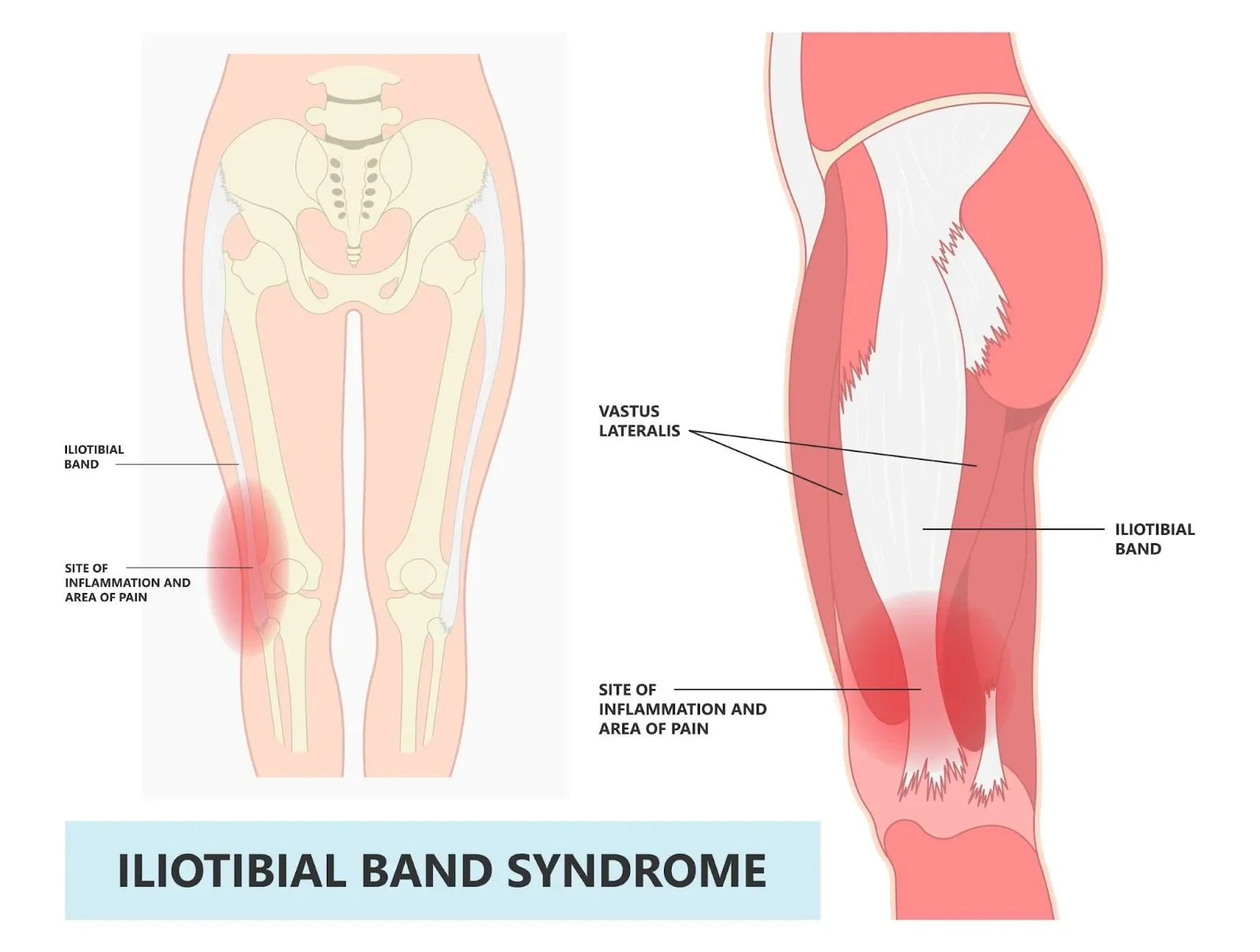
What's Actually Happening: The IT band is a thick strip of connective tissue running along the outside of your thigh, starting at the top of your pelvis, crossing your hip joint, and attaching just below your knee. For years, it was believed the pain came from the band itself rubbing against the knee, but more recent research suggests the pain actually comes from inflamed tissue and small cysts directly underneath the band, not the band itself. Either way, training factors like running repeatedly in the same direction on a track, high weekly mileage, and lots of downhill running all increase the risk, and weak outer hip and glute muscles are a major contributing factor. It's currently the second most common knee issue among runners.
How You Know It's This (Symptoms):
Aching or sharp pain specifically on the outside of the knee, distinct from runner's knee, which causes pain at the front
Pain that starts partway through a run and gets progressively worse, rather than hurting right from the first step
Pain that can linger for hours after running, sometimes into the next day
In more severe or chronic cases, pain during regular activities like sitting or climbing stairs
What To Do Right Now:
Reduce mileage immediately (don't try to run through the pain; this tends to make it worse)
Avoid downhill running and running on a banked track in one direction repeatedly
Ice the outer knee after activity
Foam rolling directly on the surrounding muscles, like the glutes and outer quad, may help you feel better, but won't fix the root cause
When to See a Professional:
Pain that hasn't improved at all after 2–3 weeks of reduced training and strengthening
Pain that's now present during daily activities like walking or sitting
Symptoms lasting beyond 8–12 weeks despite consistent effort
Returning too soon and having symptoms come right back is a sign you need more structured guidance
How to Treat It:
Hip strengthening: The single most important treatment intervention supported by evidence. The best current evidence-based protocol was described by Michael Fredericson at Stanford University and centers on hip abductor and external rotator strengthening. The IT band problem is fundamentally a biomechanical one — weakness in the glutes and hip abductors causes a predictable change in running mechanics that increases strain on the IT band. Clamshells, side-lying hip abduction, and lateral band walks are the primary exercises to focus on.
Foam rolling: Foam rolling can decrease pain and is worth doing as part of daily maintenance during recovery. However, rolling directly over the painful area on the outer knee should be avoided — this compresses the already irritated tissue directly against the bony prominence underneath and can worsen symptoms. Roll the surrounding tissue including the glutes, outer quad, and TFL instead. Research found that patients should incorporate self-myofascial release with foam rollers into their daily training routine, though it reduces stiffness temporarily rather than addressing the underlying cause.
Gait retraining: Correcting a crossover gait, where the feet land across the midline of the body rather than under the hips, is one of the most impactful biomechanical interventions for IT band syndrome. A runner with a crossover gait can sometimes say goodbye to IT band pain entirely once it's corrected. Hip drop and overstriding are also important targets to address with gait retraining.
Stretching: Stretching has limited specific evidence for resolving IT band syndrome on its own since the IT band is a tendinous sheath and can't be effectively stretched the way muscles can. Stretching the surrounding muscles including the glutes, hip flexors, and TFL is more productive than attempting to stretch the IT band directly. Stretching is appropriate as part of a comprehensive program but shouldn't be the primary focus.
Manual therapy: Different manual therapy techniques combined with hip abductor strengthening and stretching have shown effectiveness in systematic reviews, with the specific technique and treatment duration influencing outcomes. A physiotherapist or sports massage therapist working on the TFL, glutes, and lateral thigh tissue can complement the strengthening program.
Shockwave therapy: Research has shown shockwave therapy combined with hip abductor strengthening exercises demonstrated superior results within 4 weeks compared to ultrasound with stretching over 6 weeks for IT band syndrome. It's a reasonable intermediate option if strengthening and manual therapy haven't produced adequate improvement after 6–8 weeks.
Cross training: Cycling and swimming maintain fitness without the repetitive knee flexion pattern that triggers IT band symptoms. Avoid stair climbers, deep squats, and deadlifts during the symptomatic period. Running on a banked or cambered surface or repeatedly in one direction on a track should also be eliminated during recovery.
The Recovery Plan:
Week 1–2: Reduce mileage significantly, avoid downhill running and banked turns. Ice the outer knee after activity. Foam rolling directly on the IT band has limited evidence behind it, but rolling the surrounding muscles still helps you feel better.
Week 2–6: Begin hip strengthening — studies found that a 6-week hip abductor strengthening program resolved symptoms in 92% of runners. Add side-lying leg raises, clamshells, and lateral band walks 3–4x a week. Continue light, flat running if pain stays low.
Week 6–12: Before returning to full training, you should be able to do basic strength and balance tests pain-free, with pain sitting at a 2 out of 10 or less without worsening over the following 12 hours. Start back at an easy pace and find the distance you can run completely pain-free before building mileage back up.
Most people recover and return to running within about 6 weeks of consistent treatment, though this depends heavily on how severe and long-lasting the symptoms were before starting. If you trained through the pain for a long time before addressing it, expect recovery to take longer.
