Retrocalcaneal Bursitis
Severity: Mild to Moderate
Typical recovery time: Most cases improve within 8 weeks with consistent home treatment; more persistent cases may require injections or several months of management
Can I keep running? Reduce significantly or stop entirely during the acute phase
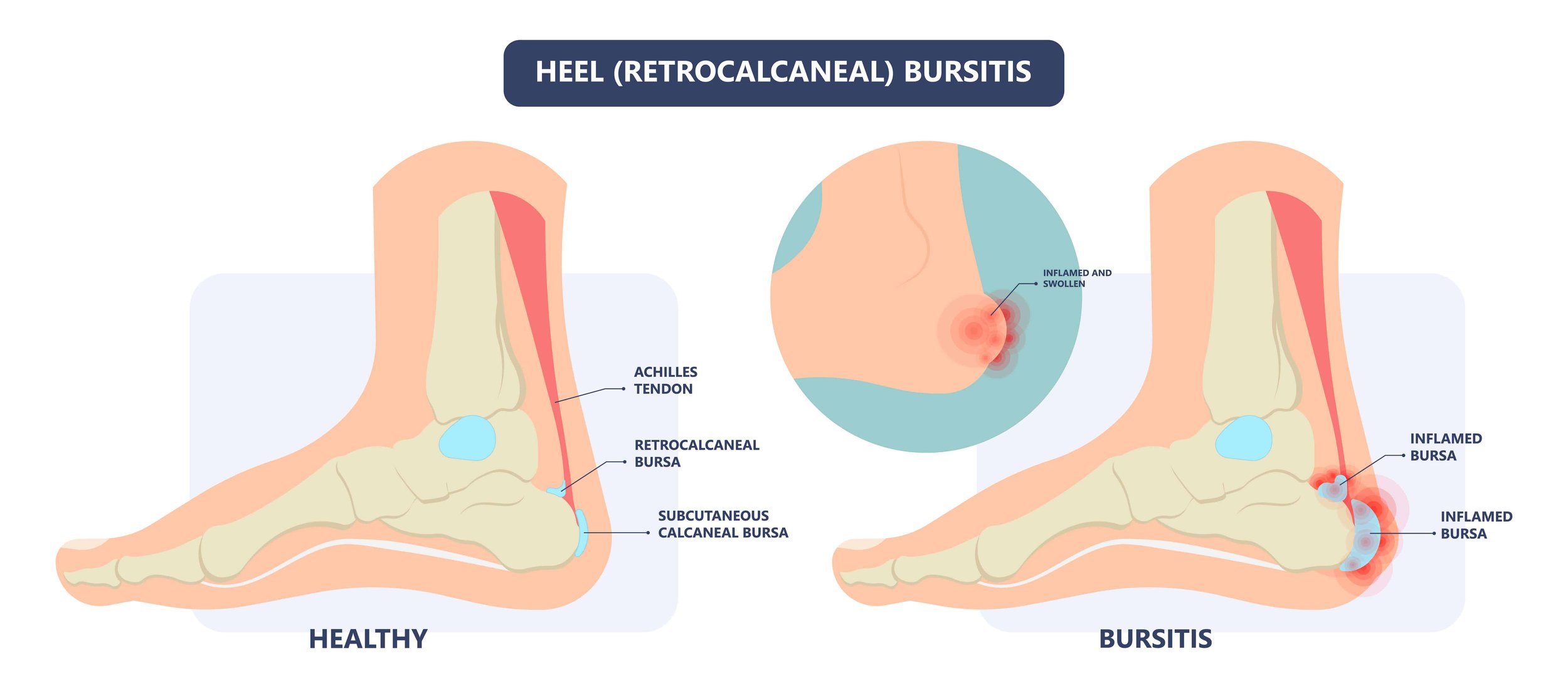
What's Actually Happening: The retrocalcaneal bursa is a small fluid-filled sac sitting between the Achilles tendon and the heel bone, acting as a cushion to reduce friction during ankle movement. When this bursa becomes inflamed from overuse, repetitive heel loading, or mechanical irritation, it causes pain, swelling, and tenderness at the very back of the heel. Retrocalcaneal bursitis accounts for 6–17% of all running injuries and is commonly misdiagnosed as Achilles tendinopathy — the two conditions share similar symptoms and can occur simultaneously, which is part of why it often goes undertreated. A contributing structural factor worth knowing about is Haglund's deformity, a bony enlargement on the posterosuperior heel bone that increases mechanical impingement on the bursa. Runners with this bony prominence are at higher risk of developing retrocalcaneal bursitis, and in these cases addressing the underlying structural issue becomes part of the management plan.
How You Know It's This (Symptoms):
Pain and tenderness at the very back of the heel, specifically where the Achilles tendon inserts into the heel bone, this location distinguishes it from mid-tendon Achilles tendinopathy which sits higher up
Swelling, redness, or warmth directly over the back of the heel
Pain reproduced by squeezing the sides of the Achilles tendon at its insertion into the heel
Pain that worsens with running and prolonged activity, and may ease somewhat with rest
Stiffness and discomfort with the first steps of the morning, similar to plantar fasciitis but localized to the back of the heel rather than the bottom
What To Do Right Now:
Reduce or stop running immediately during the acute phase
Switch to open-backed shoes or sandals temporarily to remove direct pressure on the back of the heel from the shoe collar
Ice for 15–20 minutes, 2–3 times daily to reduce inflammation
Avoid any sudden transition between very different heel heights in footwear. Going from high-heeled shoes to flat shoes or vice versa rapidly is a known trigger for this condition
When to See a Professional:
Symptoms that don't improve after 2–3 weeks of rest, ice, and footwear modification
Any visible swelling or significant warmth at the back of the heel
Persistent symptoms beyond 8 weeks despite consistent conservative treatment
If Haglund's deformity is suspected, a visible bony bump at the back of the heel, imaging and specialist evaluation are worth pursuing since this changes the management approach
How to Treat It:
Footwear modification: Changing footwear is one of the most important early interventions. Open-backed shoes remove pressure from the irritated area entirely. When returning to running shoes, ensure the heel collar is not pressing directly on the back of the heel, some runners apply padding or moleskin around the collar to prevent this. Replacing worn running shoes is important as the heel counter loses its shape over time and can begin to irritate the bursa.
Heel wedges: Over-the-counter or custom heel wedges raise the heel slightly, reducing the load and compressive force placed on the retrocalcaneal bursa during daily activity and running. This is one of the simplest and most practical interventions available.
Calf stretching and manual therapy: Tight calf muscles increase tension through the Achilles tendon, which in turn increases compressive force on the bursa. Consistent calf stretching and soft tissue therapy to the calf and Achilles region reduces this upstream load. Evidence shows that soft tissue therapy enhances circulation and reduces inflammation in the surrounding area, supporting faster recovery.
Progressive loading: Once acute inflammation settles, gradual tendon and calf loading — similar to the approach used for Achilles tendinopathy — is important for full recovery and reducing recurrence risk. Eccentric heel drops are a commonly used exercise during this phase.
Corticosteroid injections: For cases that haven't responded to conservative measures, ultrasound-guided corticosteroid injection into the bursa provides relief in a meaningful proportion of cases in the short term. Outcomes from one study showed excellent results in 37%, good in 26%, and fair in 24% of injection cases within 4 weeks. Injections should be used cautiously near the Achilles tendon due to the small risk of tendon weakening with repeated use.
Surgery: Reserved for cases that fail comprehensive conservative treatment. Endoscopic bursectomy, minimally invasive removal of the inflamed bursa, has shown better outcomes and faster recovery than open surgical techniques in comparative studies, though it requires specialist expertise. When a Haglund's deformity is present and contributing to the problem, surgical planning typically includes addressing the bony prominence alongside the bursa removal.
The Recovery Plan:
Week 1–3: Stop running, ice consistently, switch to open-backed footwear, and add heel wedges. Begin gentle calf stretching as pain allows and avoid aggressive stretching that compresses the back of the heel.
Week 3–8: Progress to manual therapy and progressive calf loading as acute inflammation settles. Light cycling and swimming maintain fitness without loading the retrocalcaneal bursa. Most cases improve within 8 weeks with consistent home treatment.
Beyond 8 weeks: If symptoms haven't meaningfully improved, corticosteroid injection is the appropriate next step before considering surgical options. Return to running should be gradual, starting on flat soft surfaces at reduced intensity, pain that returns immediately on resuming running indicates the bursa hasn't fully settled.
