Posterior Tibial Tendinopathy
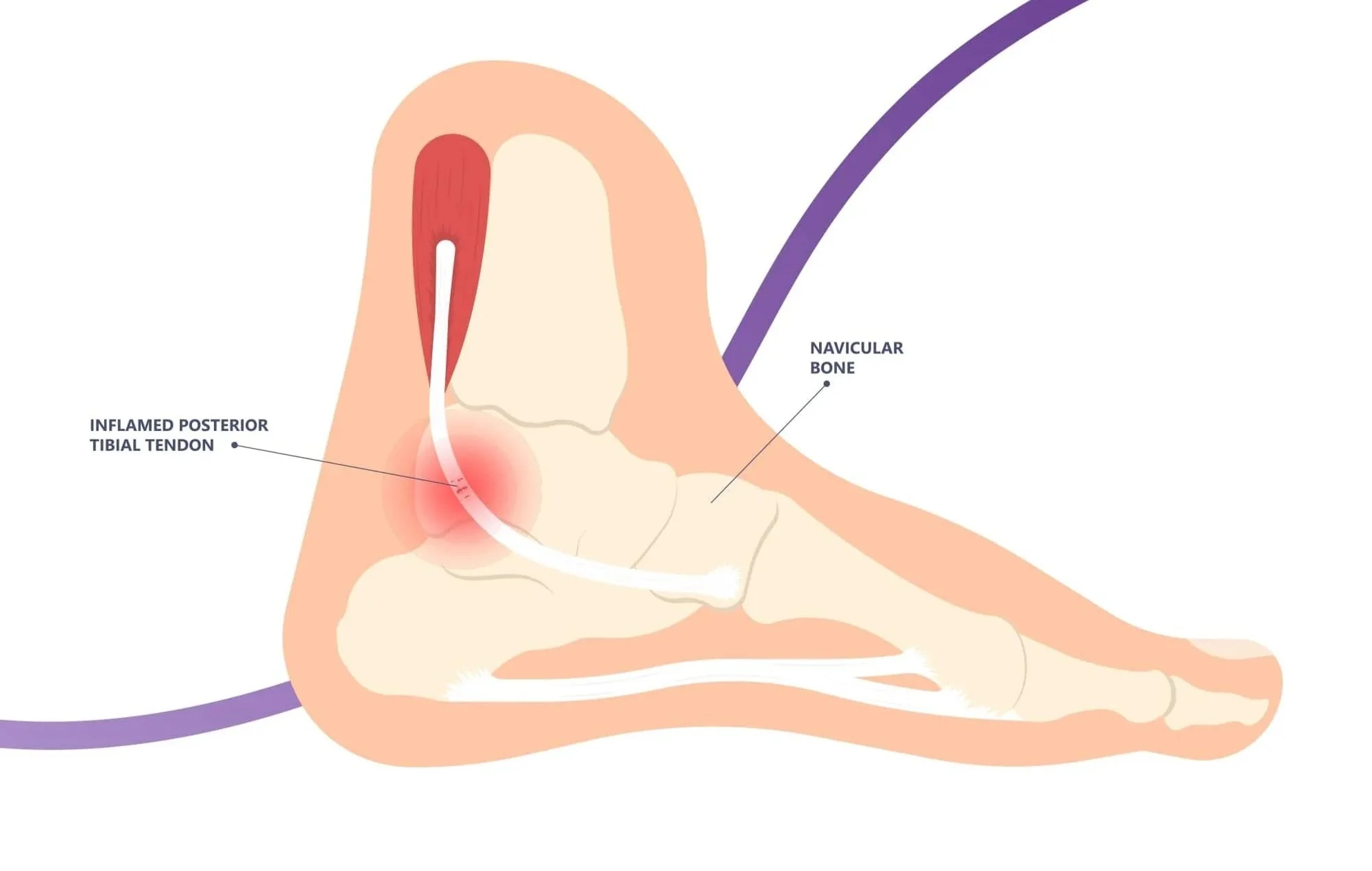
Severity: Moderate to Severe depending on stage
Typical recovery time: Early-stage cases can improve in 2–4 weeks with proper management; more established cases require at least 3 months of structured rehab before returning to running
Can I keep running? No. Pushing through it risks permanent tendon damage and structural changes to the arch of your foot
What's Actually Happening: The posterior tibial tendon runs up the inside of your ankle, connecting the tibialis posterior muscle to the bones on the inner side of the foot. Its primary jobs are supporting the arch and stabilizing the ankle during the push-off phase of running. When this tendon becomes overloaded from sudden mileage increases, overpronation, or poor footwear, it develops inflammation and micro-tearing — and if the load isn't reduced, the tendon progressively weakens and degenerates. What makes this injury uniquely serious is what happens when it's ignored: a weakened posterior tibial tendon gradually fails to support the arch, causing the foot to flatten over time. This flat-footedness then worsens the problem by increasing pronation and placing further strain on the already damaged tendon. This injury exists on a four-stage spectrum from mild tendon inflammation all the way to complete tendon rupture and significant foot deformity, catching it at Stage 1 makes a full conservative recovery entirely achievable; later stages may require surgery.
How You Know It's This (Symptoms):
Pain and tenderness along the inner ankle, either behind the inner ankle bone or running down toward the arch
Pain that worsens with running, prolonged standing, and stair climbing
In more advanced cases a visible collapse of the arch, the "too many toes" sign, where more toes than normal are visible when looking at the foot from behind, indicates the arch is flattening
Pain may ease after the first several minutes of running, then return during or after the session
An inability to complete a single-leg heel raise, or significant pain during it, is one of the clearest clinical indicators of posterior tibial tendon dysfunction
What To Do Right Now:
Stop running immediately
Supportive footwear or a temporary orthotic that supports the arch is one of the most important first steps. Walking in flat, unsupportive shoes continues to load the tendon even without running
Ice the inner ankle for 15–20 minutes after any activity
See a sports medicine doctor or physiotherapist as soon as possible
When to See a Professional:
Any inner ankle pain that persists beyond a week or two without improvement, because of the four-stage severity spectrum, early professional assessment is far better than waiting
Any visible change in your arch height or foot shape
Inability to complete a single-leg heel raise without pain
Stage 3 and 4 cases — involving significant deformity or complete tendon rupture — require surgical management and are beyond conservative treatment
How to Treat It:
Orthotics and arch support: Providing immediate mechanical support to the arch offloads the posterior tibial tendon during both daily activity and eventual return to running. Custom orthotics have the strongest evidence, though semi-rigid over-the-counter arch support insoles are a reasonable starting point. This is one injury where footwear and orthotic intervention is a treatment, not just a supportive add-on.
Progressive tendon loading: Tendons need progressive loading to heal. The standard rehab protocol progresses from isometric exercises (pushing the foot inward against resistance without movement), to concentric and eccentric strengthening, to functional movements. Single-leg heel raises, specifically the bent-knee version that targets the posterior tibial muscle, are the cornerstone exercise.
Return-to-run criteria: No published research offers a specific return timeline, but a widely used clinical benchmark is the ability to complete 50 single-leg heel raises without pain, attempting to run before reaching this benchmark significantly increases re-injury risk.
Manual therapy: Soft tissue techniques including the Graston Technique and Active Release Technique have been used successfully in documented case reports alongside progressive loading, improving both tissue quality and symptoms.
Shockwave therapy: For cases where the tendon hasn't responded adequately to conservative loading, ESWT can stimulate blood flow and tissue repair in chronically irritated tendons and is worth discussing with a sports medicine clinician.
Gait analysis: Many cases of posterior tibial tendinopathy are directly linked to abnormal loading patterns during running — overpronation, excessive tibial internal rotation, and training errors. A 3D gait analysis can identify the specific mechanical contributors and guide corrections that reduce recurrence risk.
The Recovery Plan:
Week 1–2: Stop running entirely. Begin arch support immediately with orthotics or supportive insoles. Ice after any activity. Initiate isometric tibialis posterior exercises — pressing the inside of the foot against resistance without movement.
Week 2–12: Progress to concentric and eccentric strengthening as pain allows. The Game Plan PT protocol, which allows pain up to 4 out of 10 during activity as long as symptoms resolve within 24 hours and aren't worsening week to week, is a clinically used guideline for pacing return to loading. Most clinical studies on Stage 1 cases ran 10–16 weeks, meaning at least 3 months of daily rehab work before attempting to run again.
Return to running: Begin with very short, easy flat runs only. Walk for 5–10 minutes before running to allow the tendon to warm up. If any pain returns during or after a run, back off immediately. Build over several weeks before adding any pace or volume.
