Morton's Neuroma
Severity: Mild to Moderate in most cases; Severe if left untreated long-term
Typical recovery time: 4–8 weeks; more established cases may require injections or several months of management
Can I keep running? Often yes, with shoe modifications many runners continue training with appropriate adjustments, though high mileage on hard surfaces typically worsens symptoms
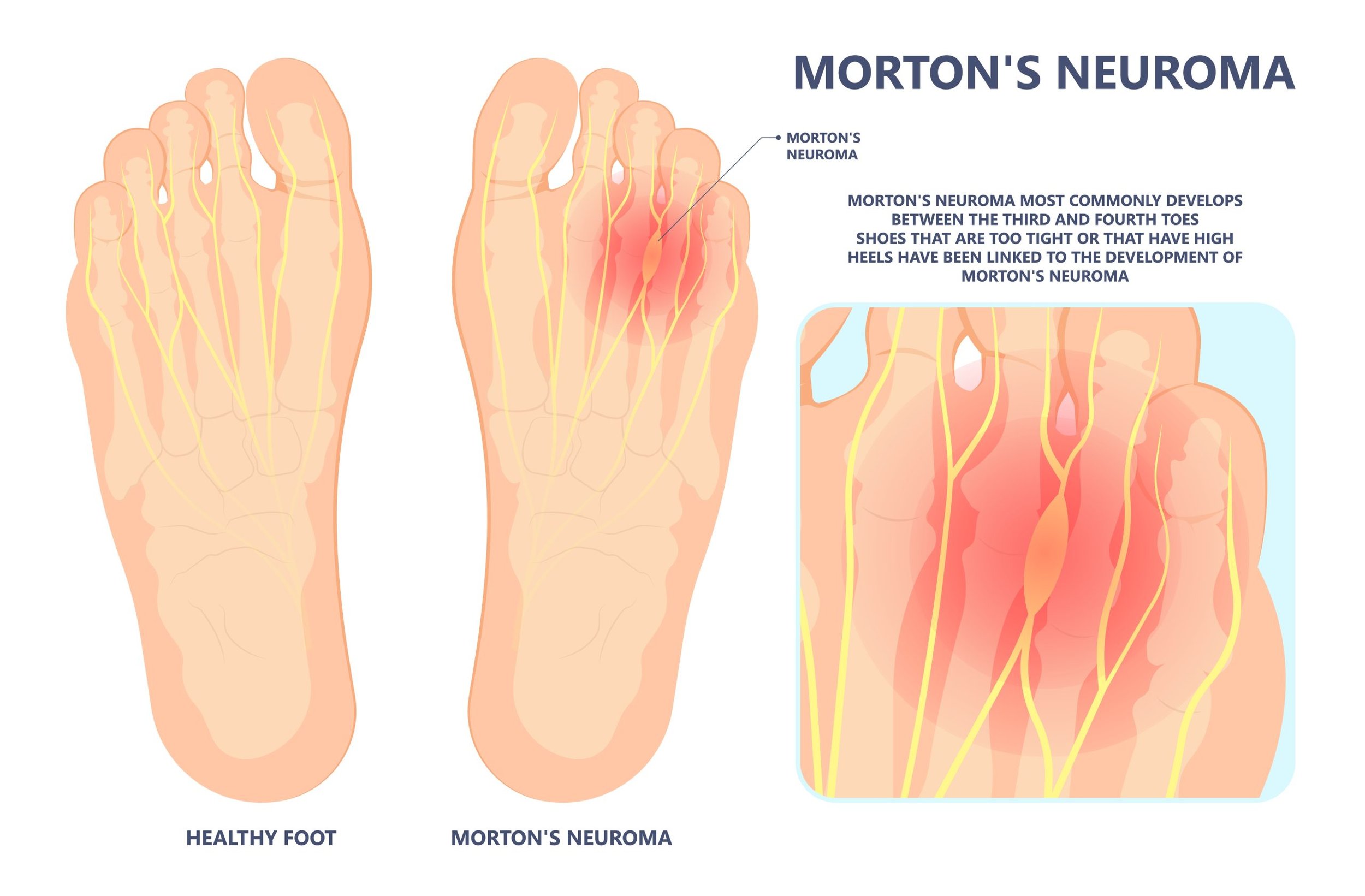
What's Actually Happening: Despite the name, Morton's neuroma isn't actually a tumor, it's a thickening and degeneration of the tissue surrounding a digital nerve in the forefoot, most commonly between the third and fourth metatarsal bones. The nerve becomes irritated and then progressively thickened when the metatarsal bones repeatedly compress it, a process that can be accelerated by narrow or pointed shoes, overpronation, and the repetitive impact forces of running. It affects approximately 30–33% of individuals with foot pain and is more prevalent in women. The condition begins gradually with subtle symptoms that become increasingly intrusive as the nerve tissue thickens further, which is why catching it early changes the outcome significantly. Runners are particularly susceptible because running places repeated stress on the metatarsal heads with every stride, and tight-fitting running shoes with narrow toe boxes concentrate compressive forces directly on the affected nerve.
How You Know It's This (Symptoms):
Burning, tingling, or sharp pain in the ball of the foot, specifically between the toes rather than at the heel or arch
A sensation of walking on a pebble or a bunched-up sock that isn't there — this specific description is one of the most distinctive features of Morton's neuroma
Pins and needles or numbness radiating into the second, third, or fourth toes
Pain that worsens when wearing tight or narrow shoes and eases when barefoot or in wide footwear
Symptoms that are worse during and after running and may linger for hours afterward
What To Do Right Now:
Switch to shoes with a wider toe box immediately
Avoid tight lacing across the forefoot, loosening laces over the ball of the foot reduces compression on the affected nerve
Add a metatarsal pad, a small pad placed just behind the ball of the foot spreads the metatarsal bones apart and directly reduces nerve compression
Reduce mileage and avoid hard surfaces while symptoms are active
When to See a Professional:
Symptoms that don't improve within 4–6 weeks of switching to wider footwear and using a metatarsal pad
Numbness or tingling that persists even when not running indicating the nerve compression is becoming more chronic
Since metatarsal stress fractures and metatarsal bursitis can mimic Morton's neuroma symptoms, professional evaluation and imaging are important when the diagnosis isn't clear
Any consideration of injections or surgery should involve a podiatrist or orthopedic foot specialist
How to Treat It:
Footwear modification: The single most important conservative intervention. Shoes with a wide toe box and adequate forefoot volume reduce the compressive forces on the nerve with every step. Narrow racing flats and pointed dress shoes are the two biggest offenders.
Metatarsal pads: Placed just behind the ball of the foot, metatarsal pads spread the metatarsal heads apart, creating more space for the nerve and directly reducing compression. These are available over the counter and are one of the most effective non-invasive tools for Morton's neuroma.
Custom orthotics: Custom orthotics with metatarsal pads and forefoot offloading provide superior long-term mechanical control compared to over-the-counter insoles and are the appropriate next step when symptoms persist or recur despite basic measures.
Ice: Applying ice to the ball of the foot after running can reduce discomfort during flare-ups, though it addresses symptoms rather than the underlying compression.
Corticosteroid injections: Appropriate after 4–6 weeks of conservative measures without adequate improvement. Injections directly into the affected interspace provide significant relief in 60–70% of cases. Repeated injections should be limited as they carry a risk of tissue damage with overuse.
Alcohol sclerosing injections: An alternative to corticosteroid injections used at some specialty centers, with success rates of around 60–80%. Used when patients aren't responsive to corticosteroids.
Surgery (neurectomy): Reserved for runners who fail 6–12 months of comprehensive conservative treatment. Surgical removal of the affected nerve segment reliably eliminates neuroma pain in approximately 80–85% of cases and typically allows return to running at 6–12 weeks post-surgery. A permanent side effect is numbness in the affected toe webspace, which is an expected outcome of the procedure rather than a complication.
The Recovery Plan:
Week 1–4: Switch to wide toe box footwear, add a metatarsal pad, reduce mileage, and avoid hard surfaces. Loose lacing over the forefoot. Many runners see meaningful improvement within this period with footwear changes alone.
Week 4–8: If symptoms haven't improved adequately with shoe modification and metatarsal pads, custom orthotics are the next step. Corticosteroid injection is appropriate at this point if conservative measures have been consistently applied without sufficient relief.
Beyond 8 weeks: Persistent symptoms despite orthotics and at least one injection cycle warrant evaluation for alcohol sclerosing injections or surgical consultation. Surgery has an 80–85% success rate for eliminating pain and is a reliable option when conservative management has been exhausted.
