Peroneal Tendinopathy
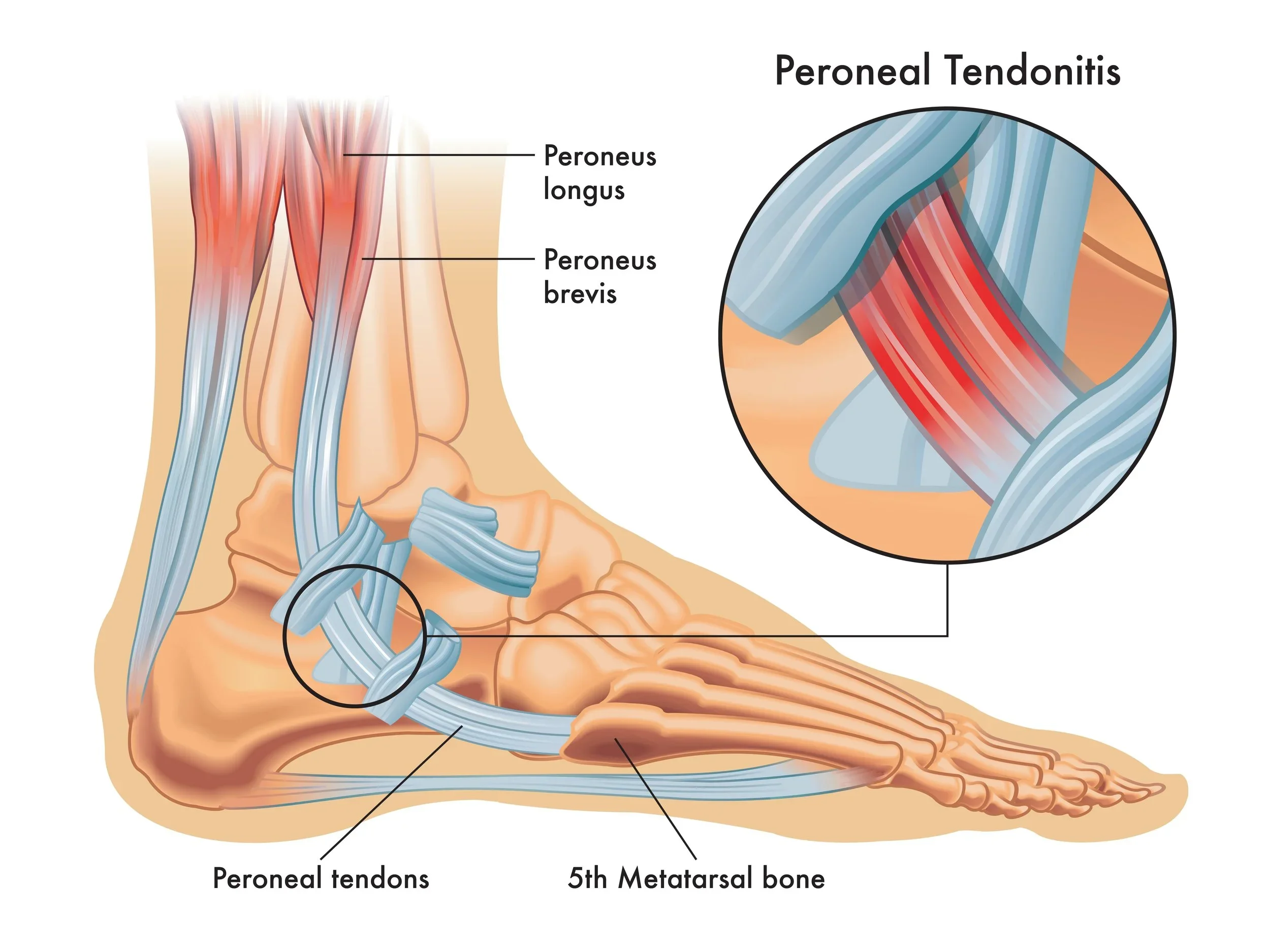
Severity: Mild to Moderate
Typical recovery time: Mild cases improve within 2–4 weeks; more persistent cases take 6–8 weeks or longer
Can I keep running? Not recommended. Continuing without addressing the root cause typically prolongs recovery and can progress to a tendon tear
What's Actually Happening: The two peroneal tendons, the peroneus longus and peroneus brevis, run down the outer side of the lower leg, wrap around the back of the lateral malleolus (the bony bump on the outside of your ankle), and attach to the foot. These tendons control foot eversion and provide crucial dynamic stability to the ankle during running. Peroneal tendinopathy develops when repetitive stress on these tendons outpaces their ability to recover, causing irritation, inflammation of the tendon sheath, and over time potential degenerative changes in the tendon tissue itself. Contributing factors include sudden increases in training volume, running on uneven or cambered surfaces, a history of ankle sprains or chronic ankle instability, high-arched feet which place extra lateral load on the tendons, and tight calf muscles that alter ankle mechanics. It's worth knowing that peroneal tendinopathy is less common than Achilles or patellar tendinopathy, one study of several thousand runners found fewer than 1% of cases, but it's also frequently misdiagnosed as a lateral ankle sprain or IT band problem, meaning it often goes unaddressed for longer than it should.
How You Know It's This (Symptoms):
Aching or burning pain along the outer ankle, either behind the lateral malleolus or further down toward the outer foot
Pain that worsens with running, particularly on uneven terrain, cambered surfaces, or during direction changes
Swelling, warmth, or thickening along the tendon path behind the outer ankle bone
A creaking or crackling sensation when moving the ankle in some cases
Tenderness directly over the tendon when pressed, distinct from the bony ankle itself
What To Do Right Now:
Reduce or eliminate activities that directly aggravate the outer ankle like running, court sports, and incline walking especially
Ice the outer ankle for 15–20 minutes several times daily during flare-ups
Avoid running on cambered roads or uneven surfaces while symptomatic
Switch to footwear with adequate lateral support
When to See a Professional:
Pain that doesn't improve after 2–3 weeks of reduced load and basic conservative care
Any snapping sensation around the outer ankle during movement. This could indicate peroneal tendon subluxation, where the tendon slips out of its groove, which requires different management
Symptoms that have been present for several months without improvement (shockwave therapy or imaging to assess tendon integrity may be appropriate at this point)
How to Treat It:
Progressive loading: As with most tendinopathies, the most important treatment principle is graduated tendon loading rather than complete rest. Heavy loading done slowly is currently the best-supported approach for tendon rehab broadly, and this applies to peroneal tendinopathy based on extrapolation from wider tendinopathy research. Resistance band eversion exercises — pushing the outside of the foot outward against resistance — directly load the peroneal tendons and are the cornerstone exercise for this injury.
Eccentric strengthening: Eccentric exercises, where the muscle lengthens under load, are well-established for tendon rehab generally. For the peroneals, slowly lowering the foot from an everted position against resistance is the eccentric component to work toward once early loading is tolerated.
Proprioception and balance training: Given the connection between peroneal tendinopathy and ankle instability history, balance and proprioception training is an important component: single-leg standing, wobble board work, and perturbation training all help restore the dynamic stability function of these tendons.
Orthotics: Custom orthotics can address underlying foot mechanics contributing to extra lateral tendon stress, particularly for runners with high arches. Worth pursuing if symptoms are recurring or not responding to basic measures.
Shockwave therapy: ESWT has good evidence for chronic tendinopathy broadly and is a reasonable next step if conservative measures haven't produced adequate improvement after 2–3 months. It aims to stimulate tissue repair and break down scar tissue in the tendon.
Taping: Ankle taping or bracing can provide short-term stability and symptom relief during the return to running phase, particularly useful on uneven cross country terrain.
What not to do: Avoid aggressive stretching of the outer ankle in the early phase, this places tension directly on the irritated tendon and can worsen symptoms. Static stretching is less useful for tendinopathy than progressive loading.
The Recovery Plan:
Week 1–2: Reduce running load significantly, ice consistently, and avoid aggravating surfaces. Begin gentle isometric eversion exercises, pressing the outside of your foot against a wall or resistance band without moving, which load the tendon safely in the early phase.
Week 2–6: Progress to resistance band eversion and eccentric strengthening as pain allows. Add single-leg balance work. Light flat running may be compatible with this phase if pain stays consistently low and settles within 24 hours after activity.
Week 6 onward: Gradually reintroduce full training load and cross country or track-specific movements. Continue peroneal strengthening as maintenance even after symptoms resolve, the tendons remain at elevated re-injury risk until full strength is restored.
