Lateral Ankle Sprain
Severity: Mild to Severe depending on grade
Typical recovery time: 1–2 weeks for Grade 1; 3–6 weeks for Grade 2; several months for Grade 3
Can I keep running? Not immediately. Return depends entirely on pain, swelling, and stability; pushing back too soon without proper rehab is the leading cause of chronic ankle instability.
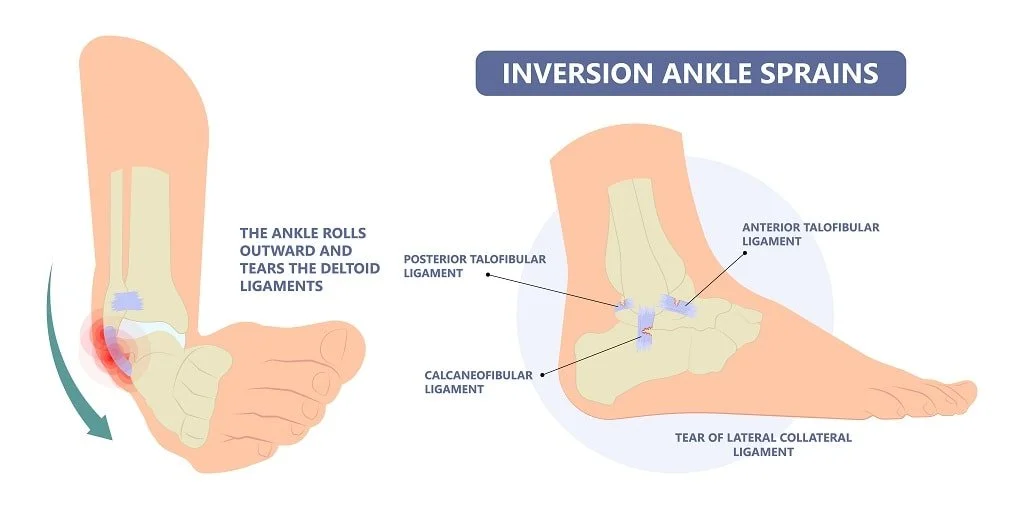
What's Actually Happening: The lateral ankle is stabilized by three main ligaments on the outer side, and a lateral ankle sprain occurs when the foot rolls inward suddenly, overstretching or tearing one or more of these ligaments. Lateral ankle sprains account for approximately 73% of all ankle sprains and are among the most common musculoskeletal injuries overall, with over 2 million cases occurring in the United States each year. Like knee ligament injuries, sprains are graded 1 through 3: Grade 1 involves mild stretching with the ligament intact, Grade 2 is a partial tear with some instability, and Grade 3 is a complete rupture with significant instability. One of the most important and underappreciated facts about this injury is that between 50–70% of people don't receive appropriate rehabilitation after an initial sprain — and those who don't are significantly more likely to develop chronic ankle instability, where the ankle repeatedly gives way and re-sprains become a recurring problem.
How You Know It's This (Symptoms):
Immediate pain on the outer side of the ankle following a sudden inward roll of the foot
Swelling and bruising that develops within hours, typically on the outer ankle
Tenderness directly over the outer ankle ligaments
A feeling of instability or that the ankle might give way, particularly on uneven ground
In Grade 3 sprains, significant difficulty bearing weight and a clear sense of looseness in the joint
What To Do Right Now:
Apply the PEACE & LOVE protocol. The current evidence-based update to the old RICE approach: Protection, Elevation, Avoid anti-inflammatories in the first 72 hours (inflammation is part of healing), Compression, Education in the acute phase; then Load, Optimism, Vascularization (gentle movement), and Exercise in the subacute phase
Ice for 15–20 minutes every 2–3 hours in the first 48 hours to control swelling
Avoid anti-inflammatory medications in the first 72 hours if possible (current evidence suggests inflammation is a necessary part of ligament healing and suppressing it early may slow recovery)
Begin gentle range of motion movements like ankle circles or alphabet writing with the foot as soon as pain allows, even in the first 24–48 hours
When to See a Professional:
Inability to bear weight at all immediately after the injury
Significant swelling, bruising, or bony tenderness over the ankle or foot bones rather than just the ligaments (could indicate a fracture)
Symptoms that don't improve meaningfully after 2 weeks of basic care
Any sense that the ankle is loose, repeatedly gives way, or re-sprains easily. This is chronic ankle instability and requires structured rehabilitation to address properly
How to Treat It:
Early movement over immobilization: Current clinical guidelines support early controlled movement rather than prolonged rest or casting for most ankle sprains. Complete immobilization leads to muscle weakness and stiffness that prolongs recovery. Gentle movement from day one is better.
Balance and proprioception training: This is the most critical and most skipped part of ankle sprain rehab. The ligament damage also disrupts the nerve endings that tell your brain where your ankle is in space and without specifically retraining this, the ankle remains vulnerable to re-injury even after it feels healed. Single leg standing, wobble board work, and perturbation training are all evidence-supported methods.
Strengthening: Peroneal muscle strengthening, the muscles on the outer lower leg that resist the inward rolling motion, is essential for preventing re-sprain. Resistance band eversion exercises directly target these muscles.
Taping and bracing: Ankle bracing or taping during return to sport reduces re-sprain risk and is strongly supported by evidence. It's not a substitute for rehab but a useful adjunct during the transition back to running, especially on uneven terrain like cross country courses.
Manual therapy: Joint mobilization and soft tissue work by a physiotherapist can restore ankle range of motion more quickly than exercise alone, particularly for Grade 2 and 3 sprains.
What not to do: Avoid complete rest beyond the first few days for mild to moderate sprains, prolonged immobilization is associated with worse long-term outcomes, not better.
The Recovery Plan:
Week 1–2: Control swelling, begin gentle range of motion work, and start weight bearing as tolerated. Even Grade 2 sprains can begin gentle movement within the first few days. Begin peroneal strengthening with resistance bands as soon as pain allows.
Week 2–6: Progress to balance and proprioception training — single leg standing with eyes open, then eyes closed, then on an unstable surface. Add sport-specific movements like lateral shuffles and direction changes as stability returns. Light jogging on flat ground is appropriate once you can walk fully pain-free without a limp.
Week 6 onward: Gradual return to full running and cross country or track training. Continue ankle strengthening and proprioception work as maintenance even after return.
