Plantar Fasciitis
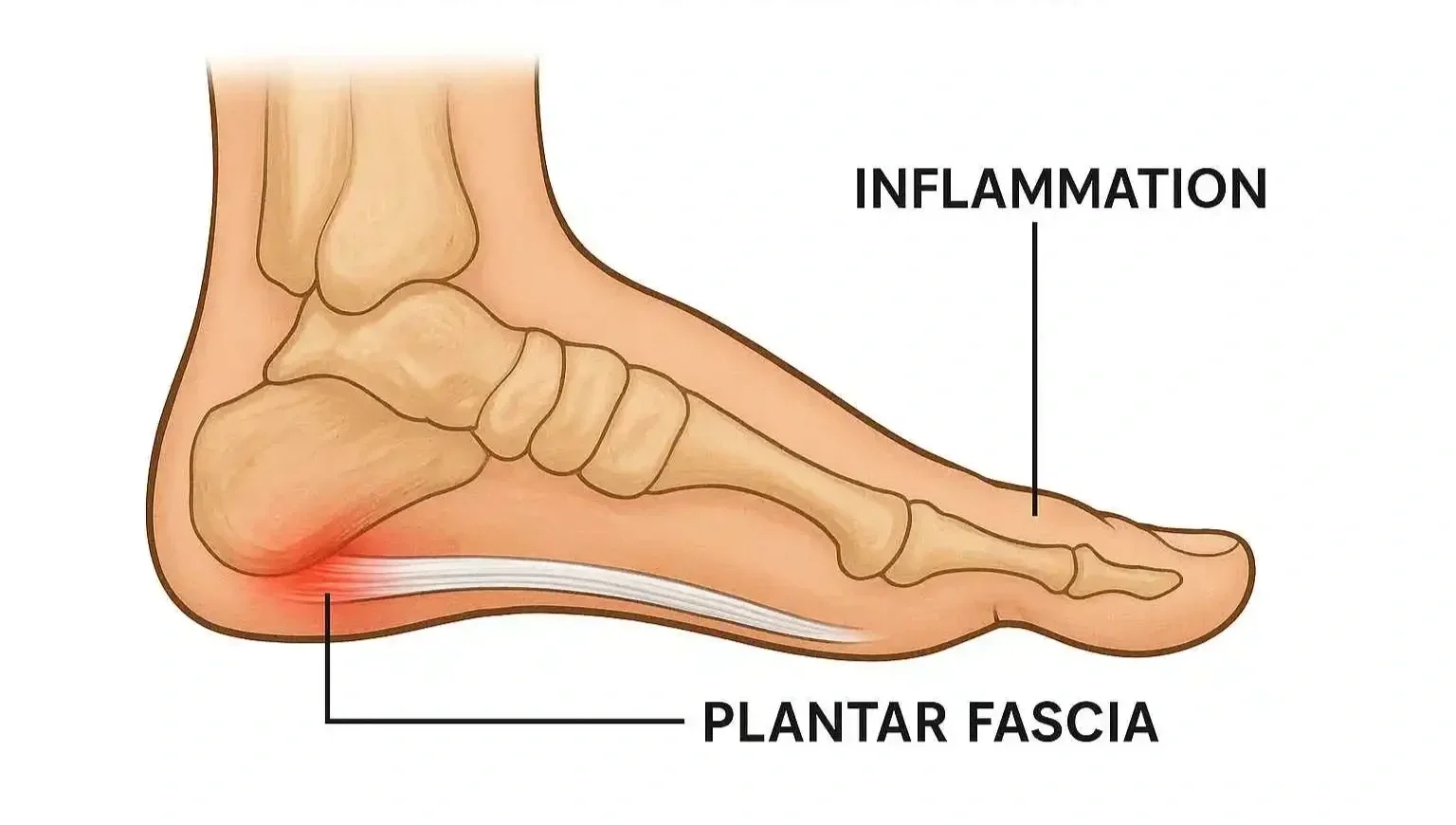
Severity: Mild to Moderate
Typical recovery time: 8–12 weeks with early and proper treatment
Can I keep running? Yes, with caution. Reduce mileage significantly and avoid hard surfaces, and stop if pain worsens during a run
What's Actually Happening: The plantar fascia is a thick band of tissue running along the bottom of the foot, connecting the heel bone to the base of the toes. Despite the name, plantar fasciitis isn't primarily an inflammatory condition, research has shown it actually involves degenerative changes and minor tears in the fascia at its insertion into the heel bone rather than true inflammation, which is part of why it doesn't always respond to anti-inflammatory treatments alone. Runners have a higher incidence than the general population, with up to 17.4% of runners affected at some point. It develops from repetitive stress overloading the fascia, common triggers include sudden mileage increases, transitioning to harder surfaces, tight calf muscles, poor footwear, and high or low arch mechanics. It typically affects one foot but occurs bilaterally in around 30% of cases.
How You Know It's This (Symptoms):
Sharp, stabbing pain at the bottom of the heel, specifically with the first steps of the morning or after prolonged sitting
Pain that may ease after a few minutes of walking but returns during or after longer periods on your feet
Tenderness directly at the front of the heel bone when pressing on the underside of the foot
Pain that worsens with increased running mileage, hills, or harder surfaces
In more chronic cases, pain that's present throughout the day rather than just in the morning
What To Do Right Now:
Reduce mileage and avoid hard surfaces (running through it consistently is the most common reason it becomes a months-long problem)
Ice the heel for 15–20 minutes after activity, rolling a frozen water bottle under the foot is a practical and effective method
Avoid walking barefoot on hard floors, especially first thing in the morning. Try to wear supportive footwear from the moment you get out of bed
Begin gentle calf and plantar fascia stretching
When to See a Professional:
Symptoms that haven't improved after 4–6 weeks
Pain that's present at rest or during normal walking, not just after activity (this needs imaging to rule out a calcaneal stress fracture)
Any concern about whether the diagnosis is correct as tarsal tunnel syndrome and calcaneal stress fractures can both mimic plantar fasciitis and require different treatment
Persistent symptoms beyond 3 months despite conservative management. At this point clinical interventions like shockwave therapy, PRP, or dry needling become worth discussing with a specialist
How to Treat It:
Stretching: The most consistently evidence-supported conservative treatment. The calf stretch (both straight-knee for the gastrocnemius and bent-knee for the soleus) and the plantar fascia-specific stretch where you pull your toes back toward your shin before taking your first steps in the morning. Perform each stretch 3 times for 30 seconds, at least twice daily.
Orthotics and footwear: Supportive insoles or custom orthotics reduce strain on the plantar fascia by improving arch support and reducing excessive pronation. Over-the-counter arch support insoles are a reasonable first step.
Night splints: A night splint holds the foot in a stretched position overnight, preventing the fascia from tightening during sleep — this directly addresses the morning pain pattern. Evidence supports their use as an add-on to stretching, particularly for people who have had symptoms for more than a month.
Taping: Low-Dye taping or kinesiology taping of the arch can provide short-term pain relief during activity by reducing tension on the plantar fascia. A sports medicine clinician or athletic trainer can show you the correct technique.
Foam rolling and massage: Rolling the bottom of the foot over a massage ball or foam roller loosens surrounding tissue and improves circulation to the area. A frozen water bottle used as a roller combines ice therapy and massage simultaneously.
Shockwave therapy (ESWT): A well-established intermediate treatment for cases that haven't responded to initial conservative measures. It involves sending shockwaves toward the heel to stimulate tissue repair and is typically considered after 6–8 weeks of conservative treatment without adequate improvement.
Barefoot running on grass: An emerging and somewhat surprising finding — one prospective study found that a 6-week barefoot running program on grass improved pain in 19 out of 20 patients at the 6-week mark and continued improving at 12 weeks. It's not a mainstream recommendation yet but worth knowing about for runners who want to explore every option.
What doesn't help as much as people think: Anti-inflammatory medications address the wrong mechanism since the condition isn't primarily inflammatory. Cortisone injections can provide short-term relief but don't address the underlying tissue problem and carry risks with repeated use.
The Recovery Plan:
Week 1–4: Reduce mileage, begin stretching protocol twice daily, switch to supportive footwear and insoles, ice after activity. Avoid barefoot walking on hard floors. Consider adding a night splint if morning pain is significant.
Week 4–8: Continue stretching and add intrinsic foot strengthening as short foot exercises and towel scrunches help rebuild the small muscles that support the arch and take load off the fascia. Taping during runs can allow continued training at reduced intensity.
Week 8–12: If symptoms have improved significantly, gradually rebuild mileage starting from well below your previous level. If symptoms haven't meaningfully improved after 6–8 weeks of consistent conservative treatment, shockwave therapy is the next evidence-supported step before considering injections or more invasive options.
