Blisters
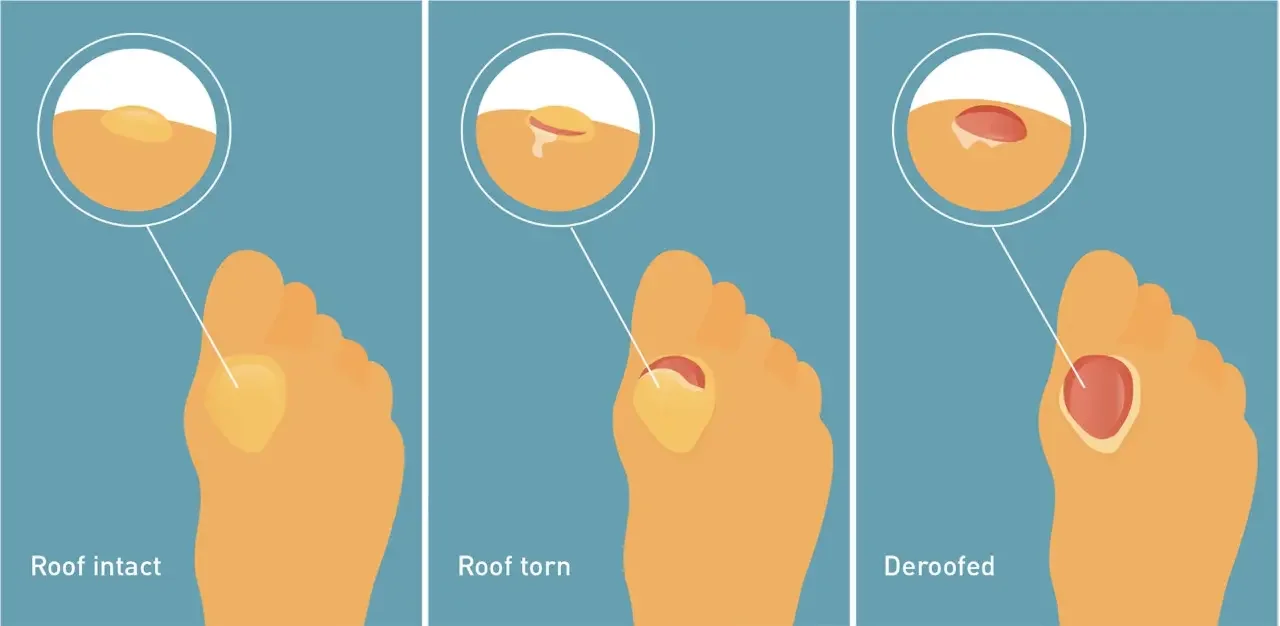
Severity: Mild in most cases; can become Moderate or Severe if infected or in a race context
Typical recovery time: Small unbroken blisters heal on their own within days; drained or broken blisters typically heal within 1 week
Can I keep running? Yes with appropriate protection
What's Actually Happening: Blisters form through a specific mechanical process involving shear forces rather than simple surface friction alone. When you run, the ground pushes backward on your shoe, your insole pushes backward on your sock, and your sock pushes backward on your skin. As you push off, all these forces reverse. The problem is that skin is soft and pliable — it moves more than the underlying bone during this cycle. This out-of-sync movement between your skeleton and soft tissue creates shear forces between skin layers, separating them and allowing fluid to accumulate in the gap. Heat and moisture are contributing factors, wet skin has a higher friction coefficient and is more vulnerable to shear damage, but the mechanical shear force is the primary driver. Common locations in runners are the heel, toes, and ball of the foot. Worth knowing: there is actually little strong scientific evidence that many popular prevention strategies reliably work for everyone, since individual skin mechanics vary.
How You Know It's This (Symptoms):
A burning or stinging sensation at a specific point on the foot during running, this "hot spot" is an early warning sign before a full blister forms
A raised, fluid-filled bubble on the skin surface after running
In infected blisters: redness spreading beyond the blister edges, warmth, pus rather than clear fluid, or increasing pain after the first 24 hours
What To Do Right Now:
If a hot spot develops during a run, apply tape or a blister plaster as soon as possible
Small, unbroken blisters that aren't causing significant pain should be left alone
Do not pop a blister unless it's large, painful, and preventing you from walking or running, the intact skin covering the blister is a barrier against bacteria
If you must drain a blister, clean the area with rubbing alcohol, use a sterile needle to make a small puncture at the edge, allow the fluid to drain, and keep the skin covering intact, do not remove it
When to See a Professional:
Any signs of infection including pus, spreading redness, warmth beyond the blister edges, red streaks moving up the foot, or fever
A blood blister that is abnormally large or extremely painful
Blisters that keep forming in the same location despite addressing the obvious causes. A podiatrist can assess underlying structural issues contributing to the problem
How to Treat It:
Hydrocolloid patches: The most effective blister treatment available. These gel-based dressings absorb fluid, create a moist healing environment, and are praised specifically for staying on during runs and significantly reducing pain. Apply to a clean, dry blister and leave in place until it naturally begins to peel at the edges.
Moleskin and donut padding: Surrounding a blister with a donut-shaped piece of moleskin relieves direct pressure on the blister during running by distributing force around rather than over it. Useful for blisters in high-pressure areas like the heel or ball of the foot.
Athletic tape: A layer of athletic tape over a hot spot or intact blister reduces friction and protects the area during continued running.
Drainage technique: For large, painful blisters that must be drained, clean with rubbing alcohol, use a sterile needle to puncture at the edge, drain the fluid, keep the skin roof intact as a biological dressing, apply an antibiotic ointment, and cover with a non-stick dressing or hydrocolloid patch.
Lubricants: Applying petroleum jelly, Body Glide, or similar lubricants to high-friction areas before running reduces shear forces between skin and sock. Evidence is mixed — some research suggests lubricants reduce friction while other studies found they may increase skin moisture and actually raise blister risk in some conditions — but many runners find them effective for specific locations.
The Recovery Plan: (For more serious cases)
Days 1–3: Keep the area clean and dry between runs. Apply a hydrocolloid patch before running to protect the blister and reduce pain.
Days 3–7: Continue hydrocolloid coverage until the blister has naturally reabsorbed or drained. Keep the skin roof intact for as long as possible.
Days 7–14: Most blisters fully heal within this window. Once the skin surface has closed and toughened, you can return to normal training without extra protection. If the same spot keeps blistering, address the root cause including footwear fit, sock choice, or lacing pattern before it becomes a recurring problem.
