Exertional Rhabdomyolysis
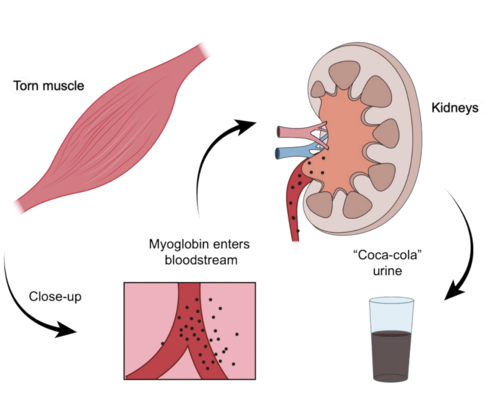
Severity: Severe, a medical emergency
Typical recovery time: Uncomplicated cases treated promptly typically resolve within 1–2 weeks. Cases involving acute kidney injury require longer hospital stays and monitoring, with full recovery taking weeks to months
Can I keep running? No. This is a medical emergency requiring immediate cessation of all activity and urgent medical evaluation
What's Actually Happening: Exertional rhabdomyolysis occurs when skeletal muscle cells are damaged by intense physical activity, causing them to break down and release their intracellular contents including myoglobin, creatine kinase, potassium, and other proteins directly into the bloodstream. Myoglobin is particularly dangerous — it's toxic to the kidneys at high concentrations and can cause acute kidney injury, which occurs in 10–50% of rhabdomyolysis cases. Running accounts for the largest proportion of exertional rhabdomyolysis cases in athletes, with runners including marathon participants making up 54.3% of cases in one systematic review of 772 athletes. The condition is underestimated — mild cases may present as nothing more than unusual delayed-onset muscle soreness with dark urine and go undiagnosed entirely. In organized athletics, 79% of cases in one review resulted from specific high-intensity conditioning sessions, highlighting how training design directly contributes to risk. Exertional rhabdomyolysis may also be the first manifestation of an underlying genetic muscle disease that lowers the exercise threshold for muscle breakdown, which is worth investigating in cases that occur without obvious extreme exertion.
How You Know It's This (Symptoms):
Severe muscle pain, stiffness, and weakness that is disproportionate to what would be expected from normal post-exercise soreness
Dark, brown, or cola-colored urine, which is the most distinctive and alarming warning sign, occurring when myoglobin spills into the urine
Muscle pain and swelling that typically develops 12–36 hours after the extreme exercise rather than immediately
Fatigue, nausea, and decreased urine output in more serious cases
Muscle weakness severe enough to significantly impair normal movement in significant cases
What To Do Right Now:
Stop all exercise immediately
Drink large amounts of water as soon as possible if you're still conscious and able to swallow, since hydration is the most important early intervention and helps dilute the toxic proteins in the bloodstream
Go to an emergency room the same day, do not wait to see if symptoms improve on their own
Tell the medical team specifically that you suspect exertional rhabdomyolysis, since an initial diagnosis is typically confirmed when creatine kinase levels are more than five times the upper limit of normal alongside a recent history of intense physical activity
Do not attempt to treat this at home regardless of how manageable symptoms seem
When to See a Professional:
Any dark, brown, or cola-colored urine following intense exercise is an emergency situation requiring same-day evaluation, not a wait-and-see scenario
Severe muscle pain following extreme exertion that is significantly worse than normal DOMS warrants prompt medical evaluation even without dark urine
Recurrent episodes of rhabdomyolysis, or episodes occurring after exercise that shouldn't be extreme enough to cause it, should prompt investigation for underlying genetic muscle disease
90% of patients in one study reported a lack of adequate follow-up care after the acute event, making post-discharge follow-up with a sports medicine physician important even after apparent full recovery
How to Treat It:
This injury is managed medically rather than through self-directed rehabilitation. The following is what medical treatment involves so you understand what to expect:
IV fluid replacement: Intravenous normal saline is the standard and most evidence-supported treatment for exertional rhabdomyolysis. The goal is aggressive hydration to flush myoglobin from the kidneys before it causes damage, targeting a urine output of 200–400 milliliters per hour for the first 24 hours. This may require IV fluid rates of 1–2 liters per hour initially in severe cases.
Sodium bicarbonate and mannitol: These can be added to IV fluid therapy in some cases. Sodium bicarbonate alkalizes the urine, reducing myoglobin toxicity to kidney tissue. Mannitol increases renal blood flow and urine output. A systematic review found no difference between IV fluids with or without sodium bicarbonate on hospitalization duration, but both remain in clinical use.
Monitoring: Creatine kinase levels, kidney function, electrolytes, and urine output are monitored closely throughout hospital admission. An ECG is obtained to evaluate for cardiac involvement since electrolyte abnormalities from muscle breakdown can affect heart rhythm.
ICU admission: If CK levels continue to rise despite treatment, urine output remains low, or profound acidosis or hyperkalemia develops, ICU admission and dialysis may be required.
Uncomplicated cases: Milder cases without significant kidney involvement can sometimes be managed with rest, oral rehydration, and outpatient monitoring rather than hospitalization, though this decision is made by a physician based on lab values and clinical assessment.
The Recovery Plan:
Acute phase (Days 1–7): Hospital management with IV fluids and monitoring until CK levels trend downward consistently and urine clears. Kidney function is the primary concern during this phase.
Subacute phase (Week 1–2): Many people experience lingering muscle weakness for several weeks after the injury even after apparent recovery. Rest from all exercise is required until medical clearance is given.
Return to exercise: No evidence-based guidelines for return to activity after exertional rhabdomyolysis currently exist, which is an honest reflection of where the research is. Return to sport is widely inconsistent among athletes in the literature. Clinically, return is guided by CK normalization, resolution of kidney function abnormalities, and clearance from a physician. The natural course in cases without underlying genetic disease suggests that return to sport is safe, but gradual and carefully monitored progression back to training is appropriate rather than resuming normal training volume immediately.
