Patellofemoral Pain Syndrome (Runner's Knee)
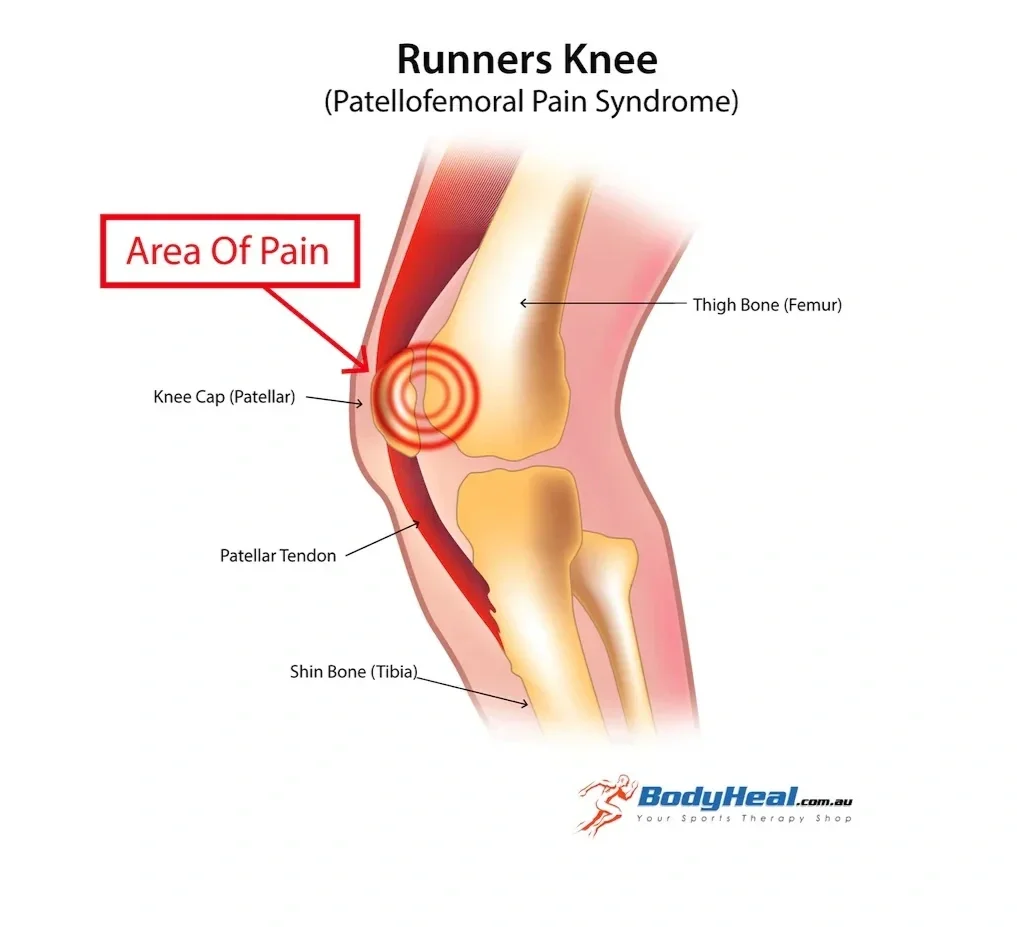
Severity: Mild to moderate
Typical recovery time: 2–6 weeks with proper treatment
Can I keep running? Usually, yes, at reduced intensity
What's Actually Happening: Runner's knee happens when the kneecap doesn't track smoothly in the groove at the end of your thigh bone as you bend and straighten your knee — usually because your hips and glutes aren't stabilizing your stride well enough, so your kneecap absorbs the extra stress instead. Research has linked it to excessive inward hip rotation and a dropping pelvis on the opposite side during running. Common triggers in cross country and track include sudden mileage increases, lots of downhill running, worn-out shoes, and weak hip and glute muscles. It's usually just a mechanical imbalance.
How You Know It's This (Symptoms):
Dull, aching pain around or behind the kneecap
Pain that worsens going downhill, downstairs, or after sitting for a long time
A grinding or clicking sensation when bending the knee
Pain that builds gradually over weeks rather than from one specific moment
No swelling or bruising (if you have either, it may be something else)
What To Do Right Now:
Cut your mileage by 30–50% for the next week, don't stop entirely
Ice the knee for 15 minutes after running
Avoid downhill running, deep squats, and stairs where possible
Switch to flatter, softer surfaces temporarily
When to See a Professional:
Pain that doesn't improve after 2–3 weeks of rest and modification
Visible swelling, warmth, or redness around the knee
A locking or "giving way" sensation (could indicate a more serious issue, like a meniscus problem)
Pain severe enough that you're limping
How to Treat It:
Hip and quad strengthening: The most consistently evidence-supported treatment for runner's knee. Recent research confirms that quadriceps and hip strengthening combined with stretching in a structured program is the most effective approach for reducing pain and improving function. Hip strengthening is just as important as quad work since weak glutes are a primary driver of abnormal kneecap loading. Start with 15 glute bridges and clamshells once daily, progressing to two to three sets as strength improves. Mini-squats on a step starting at 15 reps are a good early knee-loading exercise.
Taping: Patellar taping using either rigid athletic tape in a McConnell patellar taping technique, or kinesiology tape, has shown meaningful short-term pain relief and improved function. Research confirms that combining taping with exercise training significantly enhances knee function compared to exercise alone. Taping is best used as an adjunct during training rather than a standalone treatment.
Foam rolling and stretching: Foam rolling the quads, calves, and hip flexors loosens surrounding tissue and reduces tightness that contributes to poor patellar tracking. Avoid rolling directly over the kneecap. Stretching is a useful add-on to strengthening but doesn't provide significant benefit when used alone, so it should complement rather than replace the strengthening work. Only stretch if it doesn't irritate the knee.
Orthotics: Foot orthoses have shown improvement over placebo in clinical trials and are a reasonable option if symptoms don't respond adequately to exercise and taping alone. However, given that most research shows the root cause lies at the hip rather than the foot, orthotics should not be your first choice and should be used alongside strengthening rather than instead of it.
Cross training: Cycling and swimming are appropriate alternatives during recovery since neither significantly loads the patellofemoral joint the way running does. Avoid stair climbers and deep squats during the symptomatic period as both place significant compressive force on the underside of the kneecap.
Proprioceptive training: Balance work on an unstable surface such as a foam pad or BOSU ball helps retrain the neuromuscular control around the knee. Start with 30 seconds of single-leg standing and build as tolerated. Proprioceptive training alongside strengthening produces better outcomes than strengthening alone.
Shockwave therapy: Reserved for cases that haven't responded to several weeks of strengthening and other conservative measures. Shockwave therapy is not a first-line treatment for runner's knee but is a reasonable next step when conservative management has been consistently applied without adequate improvement.
The Recovery Plan:
Week 1: Reduce mileage, ice as needed, begin gentle quad and hip stretches. Avoid hills and speed work.
Week 2–3: Focus on hip and core strengthening alongside quad work, since current treatment guidelines emphasize this combination over isolated quad exercises. Add glute bridges, clamshells, and side-lying leg raises 3x a week.
Week 4–6: Gradually reintroduce normal mileage and light hills. Continue strength work as maintenance.
Most runners see real improvement within a few weeks once hip and glute strengthening is added, and mild cases often resolve in as little as 2–3 weeks while more stubborn cases can take a couple of months.
