Fueling For Runners
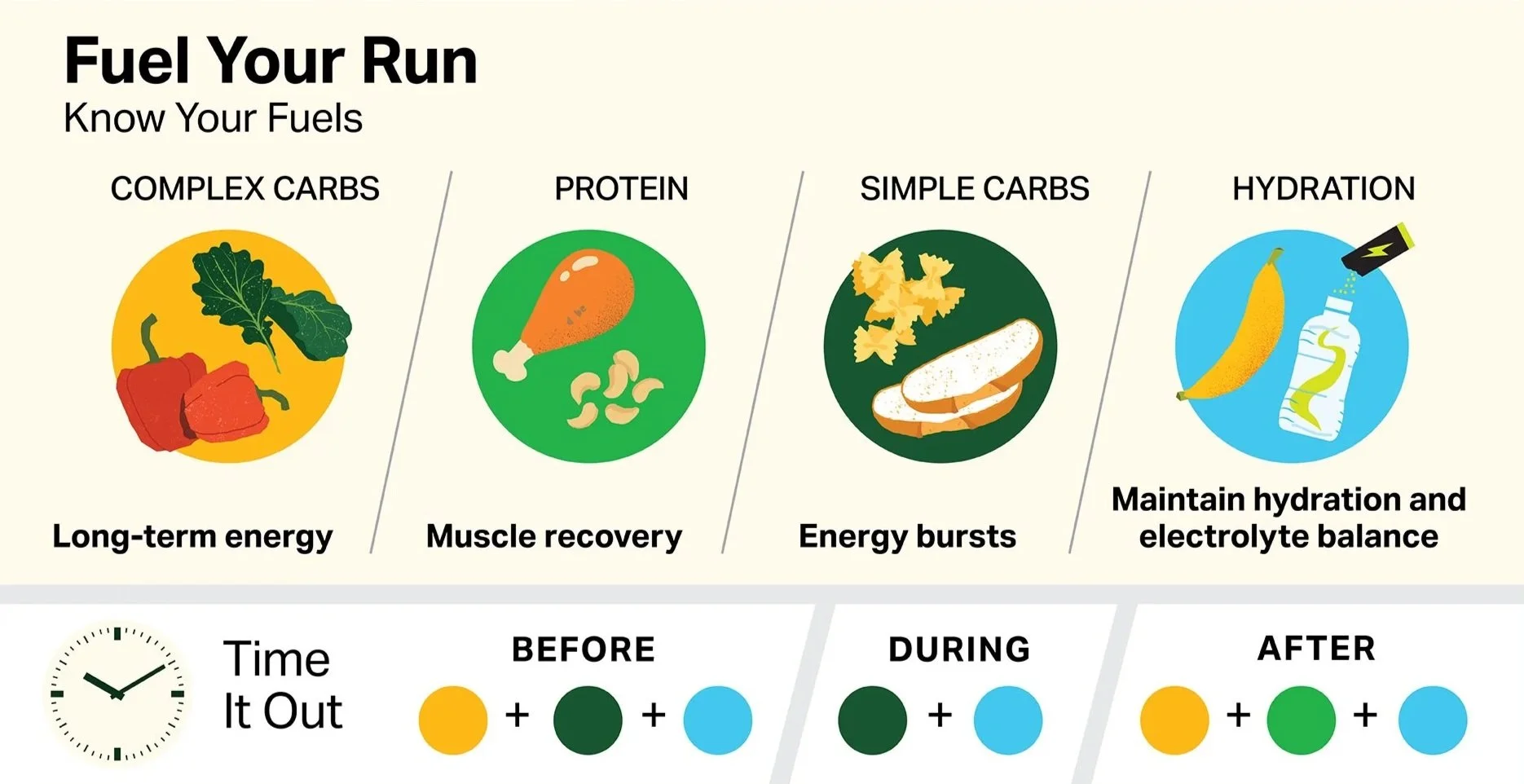
Why it matters: Food isn't just energy, it's recovery, bone density, muscle repair, and the reason your body can absorb one workout and show up ready for the next. A high school runner covering 40 miles per week burns roughly 2,800–3,200 additional calories through training alone, on top of what the body needs to grow, study, and function during a full school day. Getting this wrong directly increases injury risk in ways most runners don't connect until something breaks down.
Signs you're not fueling enough:
Fatigue that won't go away even with rest
Performance declining despite consistent training
Getting sick or injured more frequently than usual
Feeling flat and unmotivated during workouts
Stress fractures or recurring bone stress injuries
For female runners: irregular or missing periods
What your body actually needs:
Carbohydrates are your primary fuel source for all running. Your muscles run on glucose and glucose comes from carbs. Main sources: rice, pasta, oats, bread, potatoes, and fruit. These should make up the majority of your meals during the season.
Protein supports muscle repair and adaptation to training. Main sources: chicken, eggs, fish, dairy, beans, and nuts. Target roughly 1.2–1.6 grams per kilogram of bodyweight per day, spread across multiple meals.
Fats support hormone production, joint health, and long-term energy. Main sources: avocado, nuts, olive oil, and fish. Don't cut fats entirely — they play an important role in keeping hormones balanced during heavy training.
Iron supports oxygen transport in the blood and is one of the most commonly deficient nutrients in distance runners, particularly female athletes. Main sources: red meat, spinach, beans, and fortified cereals. Low iron is a common hidden cause of unexplained fatigue and declining performance.
Calcium and Vitamin D are critical for bone density and stress fracture prevention. Main sources: dairy, leafy greens, fortified foods, and sunlight. Many runners who develop repeated stress fractures are found to be deficient in one or both.
When you eat matters as much as what you eat:
2–3 hours before a run:
A full meal emphasizing carbohydrates with moderate protein. Something like rice and chicken, pasta, or oatmeal with fruit. This gives your body time to digest before you run.
30–60 minutes before a run:
Something light and easy to digest. A banana, toast, crackers, or a granola bar. Avoid high-fiber foods, fatty foods, and anything spicy, these are the most common causes of stomach problems during a run.
Within 30–60 minutes after a run:
The most important window most runners skip. Aim for a 3:1 or 4:1 ratio of carbohydrates to protein. Practical options include chocolate milk, a banana with peanut butter, rice and chicken, or a protein shake with a granola bar. Skipping this window means doing the workout but refusing to let your body finish recovering from it.
Carbohydrates (Vital):
Carbs are not the enemy. They are the primary fuel source for every type of running from a 100m sprint to a 10k. When your carbohydrate stores run out your body starts breaking down muscle tissue for energy, which is the opposite of what you want during a training block. During the season carbs should make up the majority of your meals. Cutting carbs to lose weight during a training season is one of the fastest ways to get injured.
Protein targets:
The general target for runners is 1.2–1.6 grams of protein per kilogram of bodyweight per day. Spreading protein across multiple meals is more effective than eating it all at once since the body can only use so much per sitting for muscle repair. You don't need protein shakes if you're eating enough whole food sources consistently.
Hydration:
Your urine should be pale yellow; not clear, not dark
Dehydration of just 2% of bodyweight measurably reduces performance
Start every practice and race already hydrated, drinking during a run can't fully compensate for showing up dehydrated
For runs over an hour, water alone isn't enough, electrolytes, particularly sodium, are lost through sweat and need replacing
Post-run rehydration should include electrolytes alongside water, not just water alone
In hot weather, increase both water and electrolyte intake significantly before and after training
RED-S — the injury risk most runners don't know about
Relative Energy Deficiency in Sport (RED-S) happens when calorie intake consistently doesn't match the energy demands of training. It affects both male and female runners and is more common than most people realize. Many athletes develop it unintentionally — because school schedules, late practices, and busy evenings make it hard to eat enough.
Signs of RED-S:
Unusual fatigue and poor recovery
Frequent soreness that lingers
Declining performance despite consistent effort
Recurring overuse injuries especially stress fractures
Low mood and reduced motivation
Menstrual disruption in female athletes
Getting sick frequently
RED-S consequences can begin in as little as five days of low energy availability. If this pattern sounds familiar, fueling should be the first thing examined before blaming training. See a sports medicine doctor or registered dietitian if you suspect RED-S — it's not something to self-manage.
The student athlete problem:
School schedules make fueling hard. Lunch is short, practice runs late, and by the time dinner happens it might be 9pm. A few practical habits that help:
Pack a post-run snack in your bag so the recovery window doesn't get skipped
Eat a real breakfast — skipping it means going into a full school day and often practice on empty
Keep easy snacks in your bag during the school day: granola bars, fruit, trail mix, crackers
Don't skip lunch to study — your body is still recovering from yesterday's workout during the school day
Fasted morning runs might work for some adult athletes but are not appropriate for developing teen runners with high training loads
Key Takeaways:
You are almost certainly burning more than you think, most student runners don't eat enough
Carbs are essential. Cutting them during a training season directly increases injury risk
Eat something within 30–60 minutes after every run at a 3:1 carb to protein ratio
RED-S develops unintentionally and its early signs look like overtraining, not hunger
Hydration starts before practice, not during it
If you're a female runner with irregular periods, see a doctor — it's a sign your body isn't getting enough fuel
